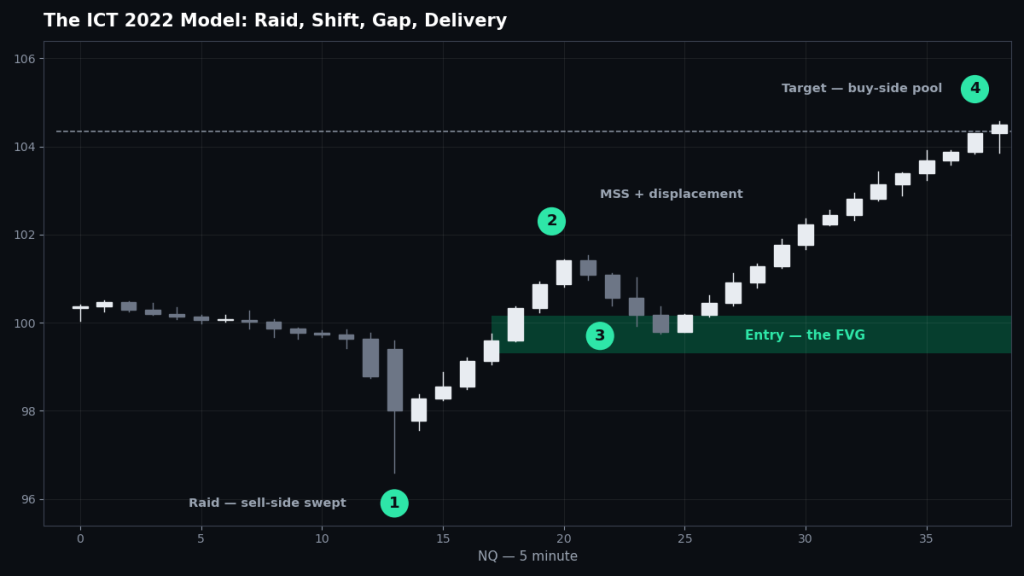
The ICT 2022 Model is ICT’s core entry model, taught in his 2022 mentorship: a five-step sequence that runs from liquidity to entry in a fixed order. First, a draw on liquidity is identified from the higher timeframe. Then, inside a killzone, price raids a liquidity pool — the sweep that stops out the crowd. Next, price shifts structure against the raid with displacement: the market structure shift. Then price retraces into the fair value gap the displacement left, and that retracement is the entry. Finally, price delivers to the opposing liquidity pool, which was the target from the start. Raid, shift, gap, delivery — the 2022 Model is not a new concept. It is every concept in this section, assembled into one repeatable trade.
What is the ICT 2022 Model?
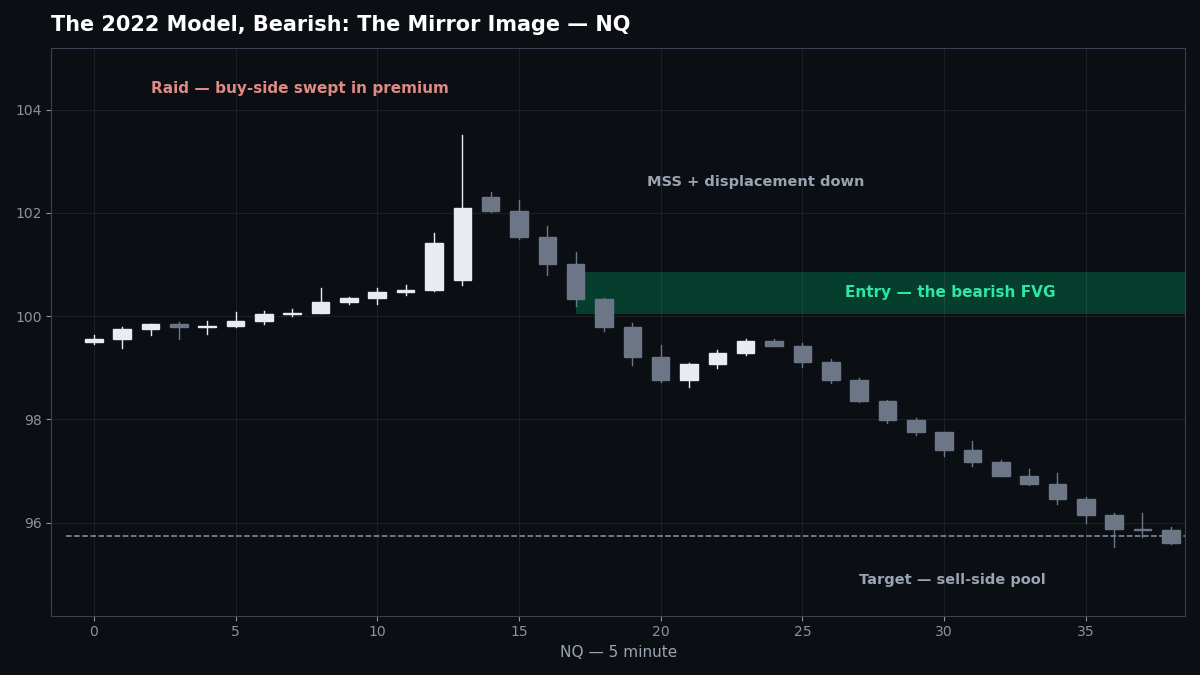
Every earlier page in this section taught one component: market structure, liquidity, premium and discount, the fair value gap. Traders who learn the components separately still freeze at the chart, because knowing the parts is not knowing the order. The 2022 Model is the order. It is the sequence ICT returned to throughout the 2022 mentorship as the canonical way a high-probability ICT trade forms — and it is deliberately unoriginal, in the best sense: each step exists to filter the step before it, so by the time an entry is offered, context, timing, trigger and target have all been decided by the market rather than by your opinion.
The model runs in both directions and on any timeframe pairing, but its home is index futures in the New York morning: a higher-timeframe frame (15-minute and 1-hour), an execution chart (1-minute and 5-minute), and the New York AM killzone as the stage. What follows is the model exactly as it will run on a normal NQ morning.
The 2022 Model, step by step
Step 1 — Frame: bias, draw, and the range
Before the session, the higher timeframe answers three questions. What is structure doing on the 1-hour and 15-minute — trending, ranging, reversing? Where is price inside its dealing range — premium, discount, or at equilibrium? And what is the draw: which pool is price working toward — the equal highs above, yesterday’s low below, a 20-day lookback extreme? The model only trades toward the draw, and only from the correct half of the range: longs are built in discount aiming up, shorts in premium aiming down. If the frame gives no clear answers, the model has no trade today, and that is a complete and valid output of step 1.
Step 2 — The raid: liquidity gets taken
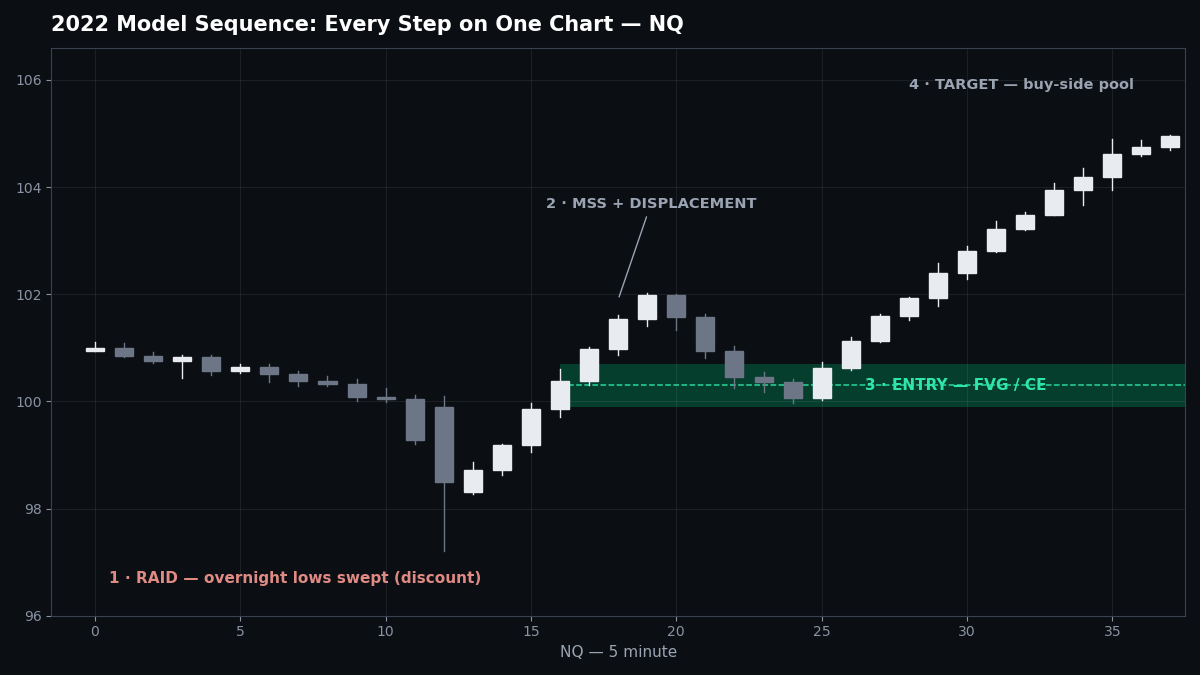
Inside the killzone, price runs the pool opposite to the trade you are waiting for — or, on continuation days, clears the near pool in the draw’s direction and keeps structure intact. The classic form is the reversal raid: on a bullish day, the morning first sweeps sell-side — the overnight low, equal lows, yesterday’s low — frequently as a Judas swing at the 8:30 data or the 9:30 open. That sweep is not the signal to buy. It is the first domino: the stops are filled, the trap is loaded, and now the model waits for proof the raid was manipulation rather than the start of a genuine breakdown.
Step 3 — The shift: MSS with displacement
Proof arrives as a market structure shift: on the 1-minute or 5-minute chart, price breaks the most recent swing against the raid direction — and does it with displacement, aggressive candles that leave a fair value gap behind them. This step is the model’s quality gate, and it is non-negotiable. A slow drift back through the swing is not a shift. A shift without a gap has no entry mechanism. The displacement is the algorithm showing its hand: delivery has changed direction, and the gap it tore in price is where you will be invited in.
Step 4 — The entry: retracement into the gap
Price retraces into the displacement’s fair value gap — to its near edge for the aggressive entry, to consequent encroachment (the gap’s midpoint) for the standard one. The order block at the base of the displacement often overlaps the gap and grades it: gap plus block plus discount (for a long) is the model’s full house. The stop sits beyond the raid extreme — the sweep’s high or low — because that is the price that proves the whole read was wrong. Note what the entry is not: it is not the sweep, not the shift candle itself, and not a market order fired in excitement during the displacement. The model enters on the retracement, at a price the plan named before the retracement began.
Step 5 — Delivery: to the opposing pool
The target was decided in step 1: the draw on liquidity — the pool on the far side of the move. Partials make sense at internal milestones (equilibrium of the morning range, the first opposing pool), but the model’s objective is the draw itself, and the trade is managed against it. Delivery completes the Power of Three shape the morning has been drawing: the overnight range accumulated, the raid manipulated, and the model’s trade rides the distribution.
How do you trade the 2022 Model on NQ?
The routine, compressed into a morning:
- 6:00–8:00 a.m.: frame it. Mark yesterday’s and the overnight extremes, equal highs and lows, the draw, the premium/discount read. Decide what a valid setup would even look like today — a bullish raid of the lows, or a bearish raid of the highs — and what would invalidate the whole idea.
- 8:30–9:30: watch, don’t chase. The data release and the cash open deliver the raid. Your only job is to confirm the sweep happened at a pool you marked.
- The shift: arm the trade. MSS with displacement on the 5-minute (confirmed on the 1-minute): draw the gap, name the entry price, the stop beyond the raid, the target at the draw. All three numbers exist before the entry does.
- The retracement: execute the plan, once. Limit or alert at the gap. No entry if price never comes back — a model that runs without you is information, not a loss.
- Delivery: manage to the draw. Partials at internal pools, stop trailed behind structure, final target the draw itself. When the pool is taken, the model is complete — whatever price does next is a new trade, not this one.
Common mistakes
- Entering at the raid. The sweep feels like the moment — it is urgent, extreme, and at a level everyone is watching. It is also the manipulation. The model’s entire design inserts the shift and the retracement between the raid and your money; skipping them is trading a different, worse model while calling it this one.
- Accepting a shift without displacement. A gentle break of a 1-minute swing, no gap, no range expansion — that is not the algorithm showing its hand, it is noise wearing the model’s clothes. The displacement requirement is the filter that keeps the model rare and good.
- Trading the model without the frame. Step 1 is not a preamble; it is half the model. A picture-perfect raid-shift-gap in premium, against a bullish higher-timeframe draw, is a short the market will use to reach the pool above you.
- Inventing a target after entry. “I’ll see how it feels” is not a target. The draw was named in step 1, and management follows from it. Trades that outstay the draw give back the model’s edge one pool too late.
- Running the model all day. The 2022 Model is a killzone model — its statistics live in the New York AM window (and, secondarily, London). The identical sequence at 1:00 p.m. in lunch chop has none of the delivery behind it. Time is a component, not a detail.
FAQ
What is the ICT 2022 Model?
ICT’s core entry model from the 2022 mentorship: a fixed sequence — higher-timeframe frame and draw, a liquidity raid inside a killzone, a market structure shift with displacement, entry on the retracement into the displacement’s fair value gap, and delivery to the opposing liquidity pool.
What timeframes does the 2022 Model use?
A higher-timeframe pair for the frame (1-hour and 15-minute) and a lower-timeframe pair for execution (5-minute and 1-minute). The shift and the gap are read on the execution charts; the draw and the bias come from the higher ones.
Is the fair value gap entry mandatory in the 2022 Model?
Yes — as taught, the entry is the gap the displacement leaves (often refined by the order block at its base). A shift with no gap offers the model no entry; waiting for one that has one is part of the discipline.
How is the 2022 Model different from the Silver Bullet?
Scope. The Silver Bullet is the same raid-shift-gap logic compressed into one fixed hour with pre-set rules; the 2022 Model is the full sequence run inside a killzone with the trader assembling the frame. The Bullet is the 2022 Model’s disciplined younger sibling.
Where is the stop in a 2022 Model trade?
Beyond the raid extreme — the high or low of the liquidity sweep that started the sequence. That price, if reclaimed, proves the raid was not manipulation and the whole read is invalid.
Can the 2022 Model be traded in the PM session?
It can, at reduced expectation: the New York PM killzone delivers real second moves, but the model’s home is the AM window, where the raids and the displacement are cleanest on NQ. Most traders run it in the morning only.
Where to go next
Every component has its own page: market structure for the shift, fair value gap for the entry, killzones for the timing, and the Power of Three for the shape the whole sequence draws. The compressed version of this model is the Silver Bullet. The full map is in the ICT section hub.