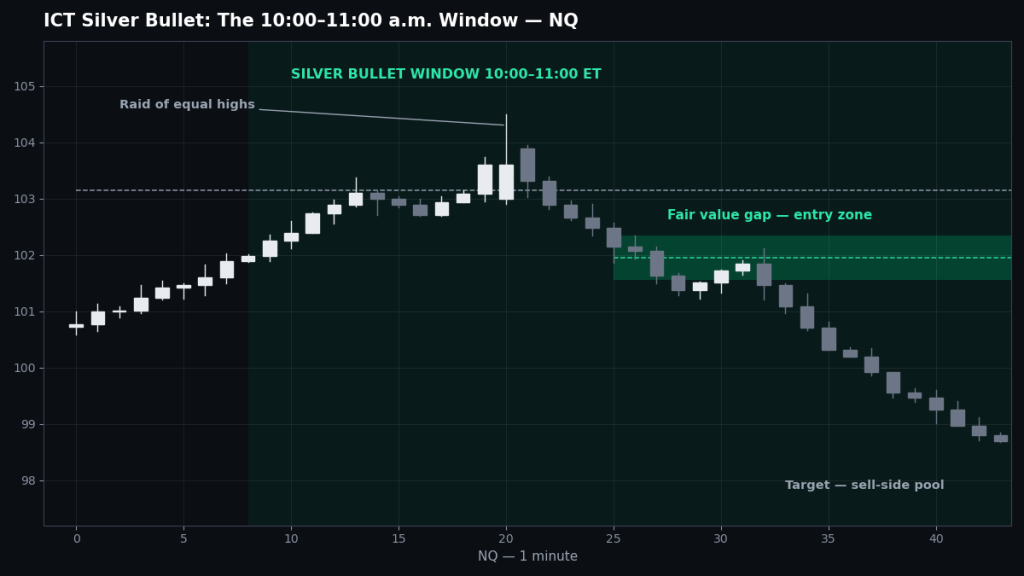
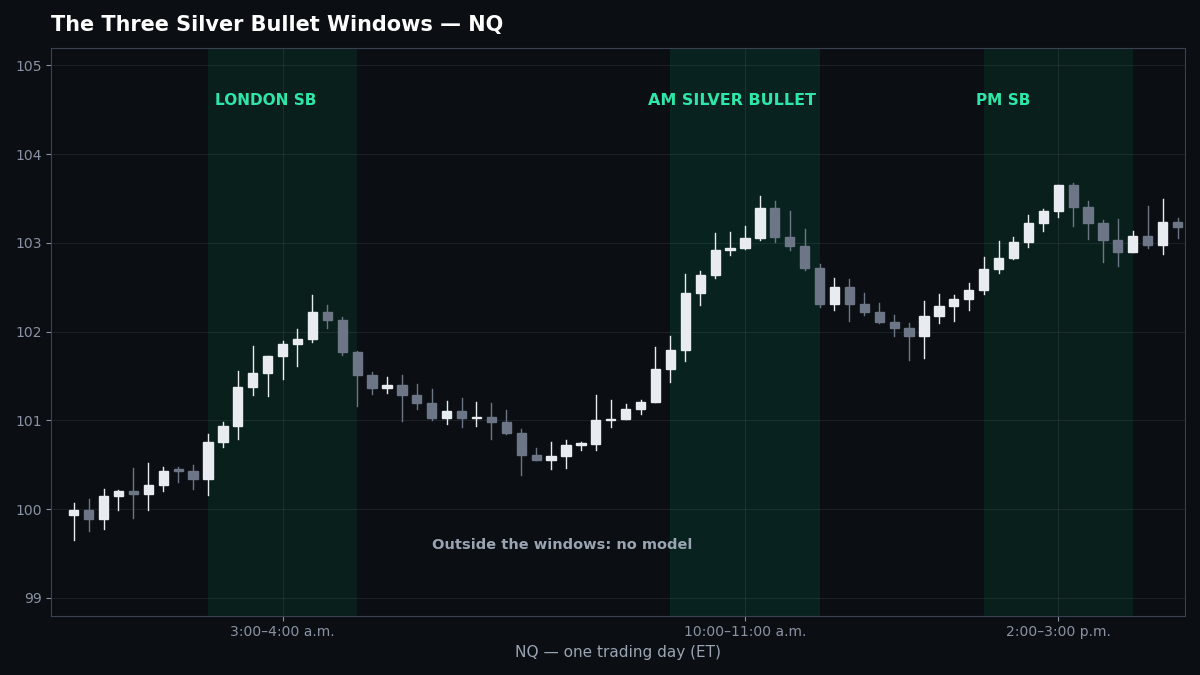
The ICT Silver Bullet is a time-boxed trading model that looks for one specific setup inside one specific hour: a liquidity raid followed by a market structure shift and an entry on a fair value gap, all inside a one-hour window. There are three Silver Bullet windows a day — London (3:00–4:00 a.m. ET), New York AM (10:00–11:00 a.m. ET) and New York PM (2:00–3:00 p.m. ET) — and the AM window is the one NQ traders build around. The model’s whole edge is constraint: a fixed hour, a fixed sequence, a fixed target at the opposing liquidity. If the setup does not form inside the hour, there is no trade — and that rule is not a limitation of the model. It is the model.
What is the ICT Silver Bullet?
Most ICT models are frameworks: bias, draw, timing, entry, all assembled by the trader. The Silver Bullet is the opposite — a recipe with the decisions pre-made. The hour is chosen for you. The sequence is fixed: during the window, price raids a nearby liquidity pool (or runs into a higher-timeframe PD array), shifts structure on the 1-minute or 5-minute chart with displacement, and leaves a fair value gap to enter on. The target is fixed too: the liquidity on the other side of the move — the pool price was drawn to all along. One hour, one sequence, one objective.
Why an hour? Because the windows are not arbitrary. Each sits inside a killzone at a moment when delivery regularly concentrates: 3:00–4:00 a.m. ET is the heart of London’s move, 10:00–11:00 a.m. is the last full hour of the New York AM killzone — after the 9:30 open’s chaos has declared a direction but before the window closes — and 2:00–3:00 p.m. is the PM killzone’s core. The Silver Bullet is ICT’s answer to the trader who knows the concepts but drowns in chart time: be present for one hour, trade one pattern, be done.
The three Silver Bullet windows
| Window | Time (ET) | Character on NQ |
|---|---|---|
| London Silver Bullet | 3:00–4:00 a.m. | London’s main delivery hour; trades the Asian range raid and expansion |
| AM Silver Bullet | 10:00–11:00 a.m. | The NQ window: post-open direction is set, the hour runs it to the pool |
| PM Silver Bullet | 2:00–3:00 p.m. | The afternoon hour; second legs and late reversals off the AM extremes |
Pick one window and master it before adding a second. The AM window suits New York-hours traders and has the deepest NQ data behind it; the London window is for early risers and overnight traders; the PM window trades at lower reliability and should be traded smaller, if at all. Trading all three from day one is how a one-hour model becomes an all-day habit with better marketing.
How do you identify a Silver Bullet setup?
The sequence inside the hour, in order:
- Before the window: know the bias and the draw. The hour does not create direction — the higher-timeframe dealing range, premium and discount and the pools from the morning’s trade decide which side you are willing to take. A Silver Bullet against the draw is just a smaller, faster mistake.
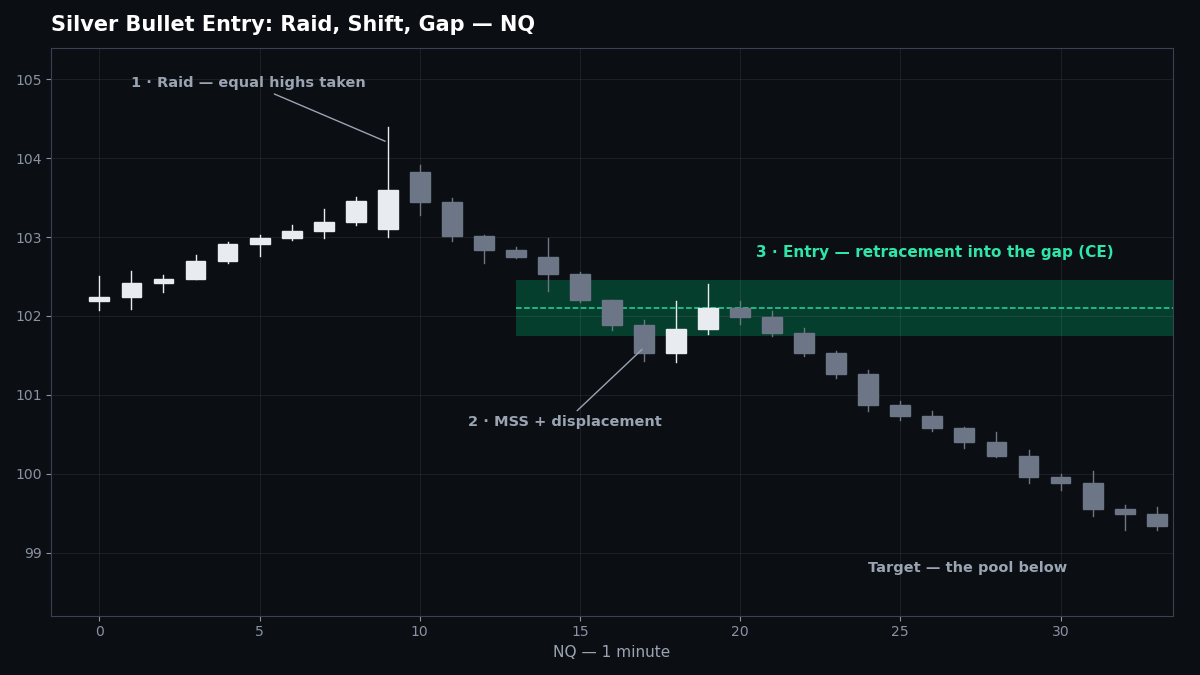
- The raid (first minutes of the hour). Price sweeps a nearby pool — the last hour’s high or low, equal highs or lows, the AM session extreme — or pushes into a higher-timeframe order block or gap opposing the move. This is the manipulation the entry is built on.
- The shift. On the 1-minute or 5-minute chart, price breaks structure against the raid with displacement: a market structure shift whose candles leave a fair value gap. No shift, no bullet — the hour can expire unused.
- The entry zone forms. The displacement’s fair value gap (sometimes paired with the order block at its base) is the entry. It must sit inside the window’s price action — a gap left over from 9:15 is not a 10:00 setup.
- The target is named before entry. The opposing pool: session highs or lows, equal highs or lows, the other side of the morning range. If the distance to it is not worth the stop beyond the gap, the setup fails the model’s own math — pass.
How do you trade the Silver Bullet on NQ?
The execution is deliberately mechanical:
- Enter on the retracement into the gap, inside the hour. Limit at the gap’s edge or its consequent encroachment, stop beyond the gap’s far side (or beyond the raid extreme if that is the cleaner invalidation).
- Target the opposing pool — the draw you named before the window opened. On NQ the classic AM bullet runs from the 10:00 raid of a short-term extreme to the session’s opposing liquidity, often completing before 11:00.
- The clock is a risk rule. If price has not delivered by the window’s close, the model is done for the day. Holding a stalled bullet into lunch “because it’s close” converts a one-hour model into an all-day exposure — the exact disease the model exists to cure.
- One window, one attempt. A stopped-out bullet is not re-entered at 10:40 with a fresh story. The recipe allows the hour one setup; forcing a second turns probability into revenge.
A concrete AM bullet: NQ trends up through the morning and makes equal highs at 9:55 just under the overnight high. At 10:05 the new hour spikes through them — buy-side raided by a few points — and stalls. A 5-minute displacement down leaves a bearish fair value gap, an MSS against the morning’s last leg. The short fills on the retracement into the gap at 10:15, stop above the raid, and price delivers down to the sell-side pool under the 9:30 low by 10:50. Raid, shift, gap, pool — inside one hour, inside the model’s rules.
Common mistakes
- Trading the setup outside the hour. A perfect raid-shift-gap at 11:20 a.m. is not a Silver Bullet — it is a different model or no model. The time box is what makes the statistics of the pattern mean anything; break it and you are trading anecdotes.
- Skipping the bias step because “the model is mechanical.” The sequence is mechanical; the direction is not. Bullets fired against the higher-timeframe draw, out of premium when long or discount when short, are the model’s most common losing trade.
- Entering on the raid. The sweep in the first minutes is the trap forming, not the entry. The entry is the gap after the shift. Traders who short the raid itself are providing the liquidity the shift is about to run through.
- Moving the target mid-trade. The opposing pool was the objective when the plan was made. Extending targets because “it’s moving well” turns a defined model into open-ended hope, and the window’s close will eventually make the decision for you — at lunch prices.
- Trading all three windows at full size. The windows are not equals. London and PM bullets on NQ carry less of the day’s delivery than the AM bullet. One window mastered beats three windows dabbled in.
FAQ
What are the ICT Silver Bullet times?
Three one-hour windows in Eastern Time: London 3:00–4:00 a.m., New York AM 10:00–11:00 a.m., and New York PM 2:00–3:00 p.m. The AM window is the primary one for NQ futures.
What is the Silver Bullet setup, exactly?
Inside the hour: a raid of a nearby liquidity pool, a market structure shift with displacement on the 1-minute or 5-minute chart, and an entry on the fair value gap the displacement leaves — targeting the opposing liquidity pool.
Do I need a fair value gap for a Silver Bullet?
Yes — the FVG is the model’s entry mechanism. A shift without a gap is a signal without the recipe’s entry; ICT’s model as taught requires the imbalance to enter on.
What is the Silver Bullet target?
The opposing liquidity: the pool on the other side of the move — session extremes, equal highs or lows, the far side of the morning range. It is named before entry, and if the distance does not justify the stop, the setup is passed.
Can the Silver Bullet be traded on NQ?
It suits NQ well: the AM window sits inside the New York killzone where NQ’s delivery concentrates, and the pair of 1-minute/5-minute structure and gaps the model needs forms cleanly on a single central feed.
What if no setup forms during the hour?
Then the model did its job — it kept you out. A Silver Bullet day with no trade is a normal outcome, not a missed one. The hour expiring unused is the price of the model’s discipline.
Where to go next
The Silver Bullet is one window of the ICT killzones turned into a recipe — read that page for the full clock. Its parent sequence, unboxed from the hour, is the ICT 2022 Model, and the shape both models draw is the Power of Three. The full map is in the ICT section hub.