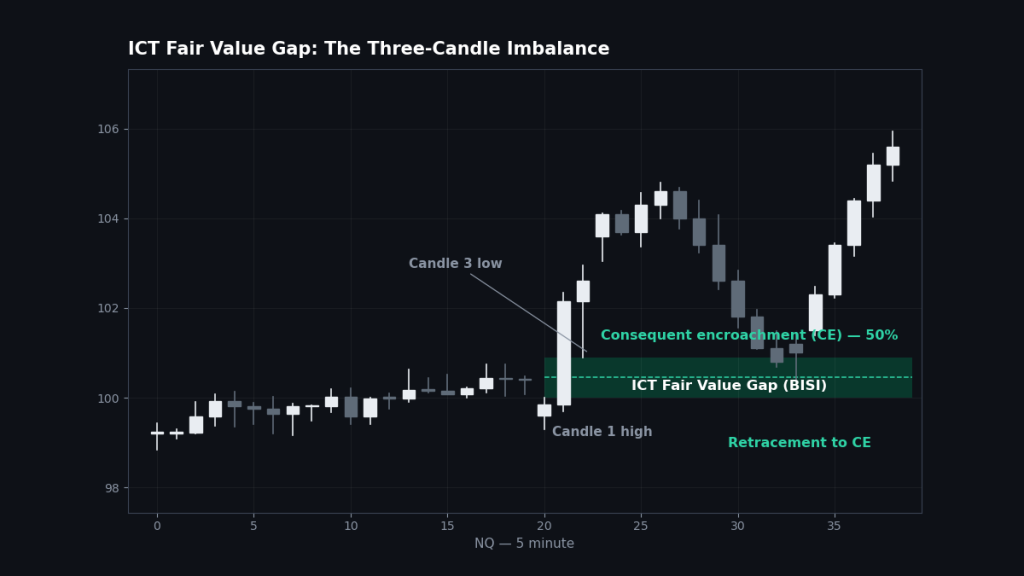
An ICT fair value gap is a three-candle imbalance where price moved so fast that it left a space between the first candle’s extreme and the third candle’s extreme that was never traded through in an orderly way. In a bullish fair value gap, the low of the third candle sits above the high of the first candle, and the space between those two levels is the gap. That space is unfinished business: price delivered to one side only, and the algorithm tends to come back and rebalance it. ICT traders use the fair value gap as an entry zone, a target, and proof of displacement — it is the single most-used PD array in the framework, and it only means anything when structure and liquidity give it context.
What is an ICT fair value gap?
Think of a normal three-candle sequence. The candles overlap: each new candle trades back through part of the candle before it, buyers and sellers both get filled, and value is established across the whole range. Now think of a displacement move — a raid reverses, or news hits, and price launches. The middle candle is a large, aggressive candle. The candle after it opens and keeps going without ever trading back down to the level where the candle before the big one topped out. Between the high of the first candle and the low of the third, there is a stretch of price where only one side ever traded. That stretch is the fair value gap.
ICT has its own names for the two directions, and you will see them in the community:
- Bullish fair value gap — BISI (buy-side imbalance, sell-side inefficiency). Price ripped upward; the buyers were aggressive and the sellers never got a fair chance to trade inside the gap. The gap acts as potential support when price returns to it.
- Bearish fair value gap — SIBI (sell-side imbalance, buy-side inefficiency). Price dropped hard; the gap is the space between the low of the first candle and the high of the third. It acts as potential resistance on a return.
Why does price come back to gaps at all? Because delivery inside the gap was inefficient. Only one side of the market was served there, and the algorithm’s job is to offer fair value — two-sided trade — across the prices it delivers. ICT traders call the return trip rebalancing. It does not have to happen immediately, and it does not have to happen completely, but a fresh gap in the right context is one of the most reliable reaction zones on a futures chart.
One level inside the gap matters more than the edges: the midpoint of the gap is called consequent encroachment (CE) — literally, the “following half.” Price frequently reacts at the CE before filling the whole gap, and many entries are taken at the CE of a larger gap rather than at its edge. Mark the gap, mark the CE, and you have the two prices your trade plan revolves around.
How do you identify a fair value gap?
Work through these steps on your execution timeframe:
- Find the displacement first. Gaps appear inside aggressive moves — after a liquidity raid, at a market structure shift, out of a killzone open. If the move that created the gap is lazy, overlapping and slow, what you are looking at is probably not a tradeable imbalance.
- Check the three candles. Bullish: is the third candle’s low strictly above the first candle’s high? Bearish: is the third candle’s high strictly below the first candle’s low? If the extremes touch or overlap, there is no gap — no matter how fast it felt live.
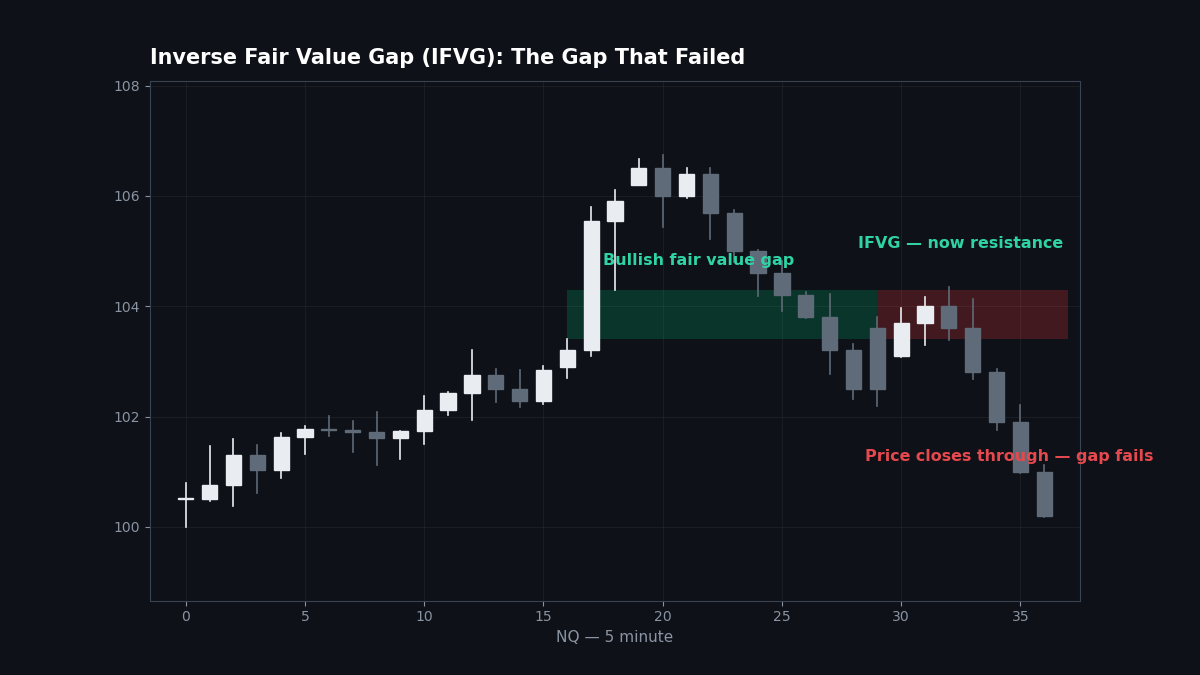
- Draw the zone. Extend the gap forward as a box between the two extremes, and draw the CE line through its middle. The zone stays live until price closes through it entirely — at which point it is no longer a gap, and its meaning flips (that is the inverse fair value gap, below).
- Grade it by context, not size. A gap is only as good as where it sits: in discount for a long or premium for a short, in line with higher-timeframe structure, aimed at a liquidity pool on the other side. A huge gap in the wrong half of the range, against the draw, is decoration.
- Check the clock. Gaps formed inside a killzone — New York AM especially — carry the delivery of the session. A gap formed in the 1:00 p.m. lunch chop is a rumour, not a plan.
What is an inverse fair value gap (IFVG)?
An inverse fair value gap is what a gap becomes when it fails. When price closes through a fair value gap — a full candle close beyond the far edge — the imbalance is considered violated, and the same price zone inverts its polarity. A bullish gap that price closes below stops being support and becomes resistance: an inverse fair value gap that sellers will defend on a retest. A bearish gap that price closes above becomes support.
The IFVG matters because failed gaps are information. When a fresh gap with displacement behind it gets run over, the market is telling you the delivery you thought you were watching is not in control. ICT traders treat the IFVG as a high-quality PD array in its own right — often as the first entry zone after a genuine change in delivery, because the retest of an inverted gap lines up with the traders who entered on the original gap now scrambling to get out. If the fair value gap is the framework’s favourite continuation tool, the IFVG is its favourite failure signal: same zone, opposite conclusion, drawn from what price actually did.
How do you trade fair value gaps on NQ?
The gap is never the trade by itself. It is the entry mechanism inside a sequence the rest of this section builds. The working method:
- Set the stage with the foundations. Structure gives the bias, liquidity names the draw, premium and discount say which half of the range you may act in. (If any of those three are missing, start at the ICT section hub and work through Week 1 first.)
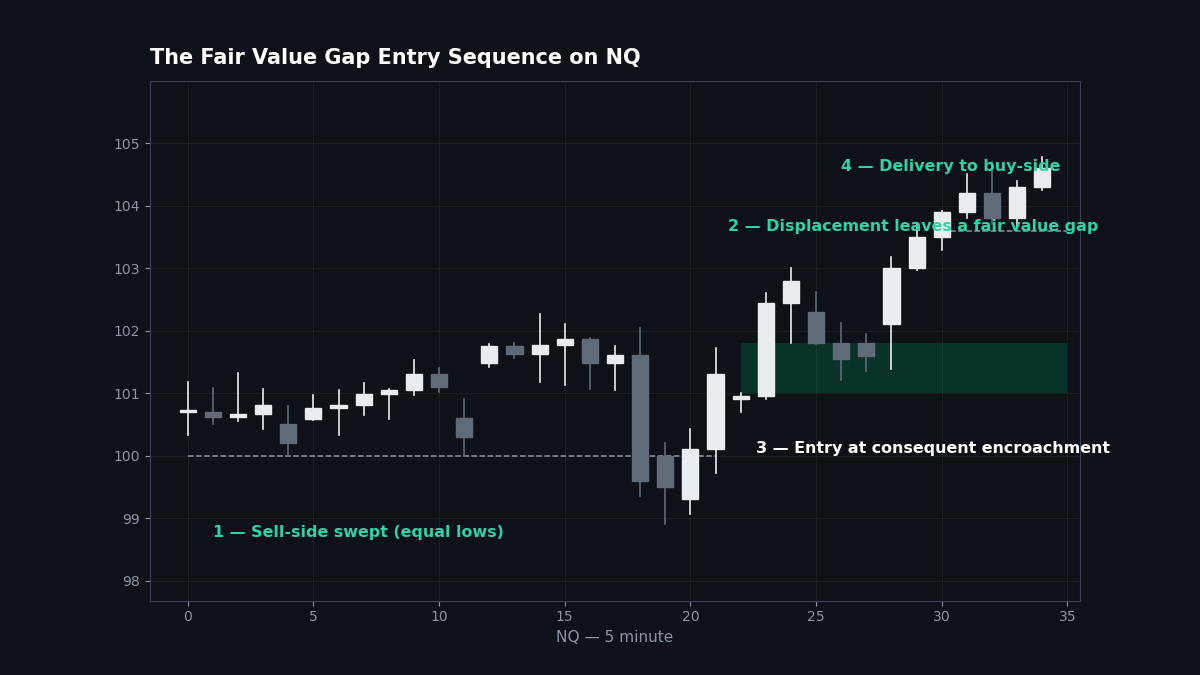
- Wait for the raid and the shift. The highest-quality gaps are born in the displacement that follows a liquidity sweep — the market structure shift off the swept pool. That displacement candle (or series) leaves the gap you will trade.
- Enter on the retracement. Price comes back into the gap. Aggressive entry: at the gap’s near edge. Standard entry: at consequent encroachment, the midpoint. Your stop lives beyond the far edge of the gap — or beyond the swing that created the displacement, if that is closer and cleaner.
- Target the draw. The trade’s objective is the liquidity pool price was always working toward — the equal highs, the old high, the overnight extreme on the far side of the move. The gap got you in; the pool gets you out.
- Manage the failure honestly. If price closes through the gap against you, the gap is violated — exit, and note the new IFVG. Do not average into a zone the market has just told you is dead.
A concrete NQ morning: the overnight session stalls under equal lows. At 9:35 a.m. ET the cash open dives through them — sell-side swept — and immediately reverses. A strong 5-minute displacement candle launches off the sweep low and leaves a bullish fair value gap behind it, in discount of the overnight range. Price retraces into the gap’s CE at 9:50, holds, and delivers up through the overnight high by 11:00. Raid, shift, gap, delivery — the whole ICT 2022-style sequence, with the fair value gap doing the entry work.
Common mistakes
- Trading every gap on the chart. A 1-minute chart shows dozens of gaps a day. Most are noise inside indecision. A gap earns a trade only when displacement, structure and liquidity put it there — context is the filter, the gap is just the zone.
- Ignoring which side of the range the gap is on. A bullish gap deep in premium, after buy-side has already been taken, is a trap wearing a setup’s clothes. Check the gap against premium and discount before you even think about entering.
- Treating a partial fill as failure. Price does not owe you a full rebalance. Reactions at consequent encroachment are normal and expected — if your plan requires the gap to fill to the tick before working, your entries and stops are in the wrong places.
- Calling a closed-through gap “still valid.” A full close beyond the far edge ends the gap’s life in its original direction. After that it is an inverse fair value gap, with the opposite read. Arguing with that is how small losses become donations.
- Hunting gaps outside the windows. The same gap at 10:00 a.m. and at 2:30 p.m. is not the same gap. Delivery on NQ happens in the killzones; gaps born in dead hours carry dead-hour reliability.
- Mixing up BISI and SIBI. A bullish gap is a buy-side imbalance (BISI); a bearish gap is a sell-side imbalance (SIBI). Getting the label backwards in your journal gets the direction backwards in your head — write it down properly every time.
FAQ
What is a fair value gap in ICT?
A three-candle imbalance: the low of the third candle sits above the high of the first (bullish), or the high of the third sits below the low of the first (bearish), leaving a space where only one side traded. Price tends to return and rebalance that space.
What is the difference between a BISI and a SIBI?
A BISI (buy-side imbalance, sell-side inefficiency) is a bullish gap left by aggressive buying. A SIBI (sell-side imbalance, buy-side inefficiency) is a bearish gap left by aggressive selling. The first name in each pair is the side that was aggressive; the second is the side that got skipped.
What is consequent encroachment?
The midpoint of the fair value gap — the 50% level between its two edges. Price often reacts at the CE before filling the whole gap, and many ICT entries are taken there rather than at the gap’s edge.
What is an inverse fair value gap (IFVG)?
A fair value gap that price has closed through. Once violated, the gap inverts: a bullish gap closed below becomes resistance, a bearish gap closed above becomes support. IFVGs are used as entry zones in the new direction.
Does a fair value gap always get filled?
No. Price tends to rebalance gaps, and often does so to the consequent encroachment at minimum, but a gap can stay open for sessions — or be run through entirely, which inverts it. Treat the fill as a tendency that gives you a zone, never as a guarantee.
Which timeframe has the best fair value gaps?
The one that matches your structure read. On NQ, 5-minute and 15-minute gaps inside the New York AM killzone do most of the entry work; 1-minute gaps refine the entry. Higher-timeframe gaps (1-hour, daily) act as larger objectives and reaction zones.
Where to go next
The fair value gap is one PD array; the ICT order block is its closest partner — the two usually appear together inside the same displacement. Breakers, mitigation blocks and the rest of the block family are in breaker and mitigation blocks. All of it sits inside the map in the ICT section hub, built on the foundations of market structure and liquidity.