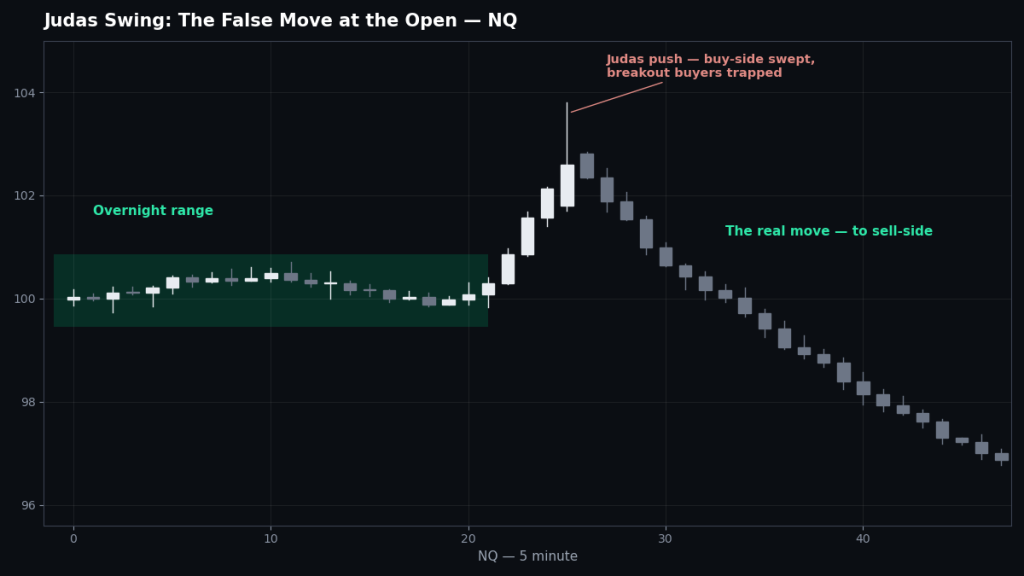
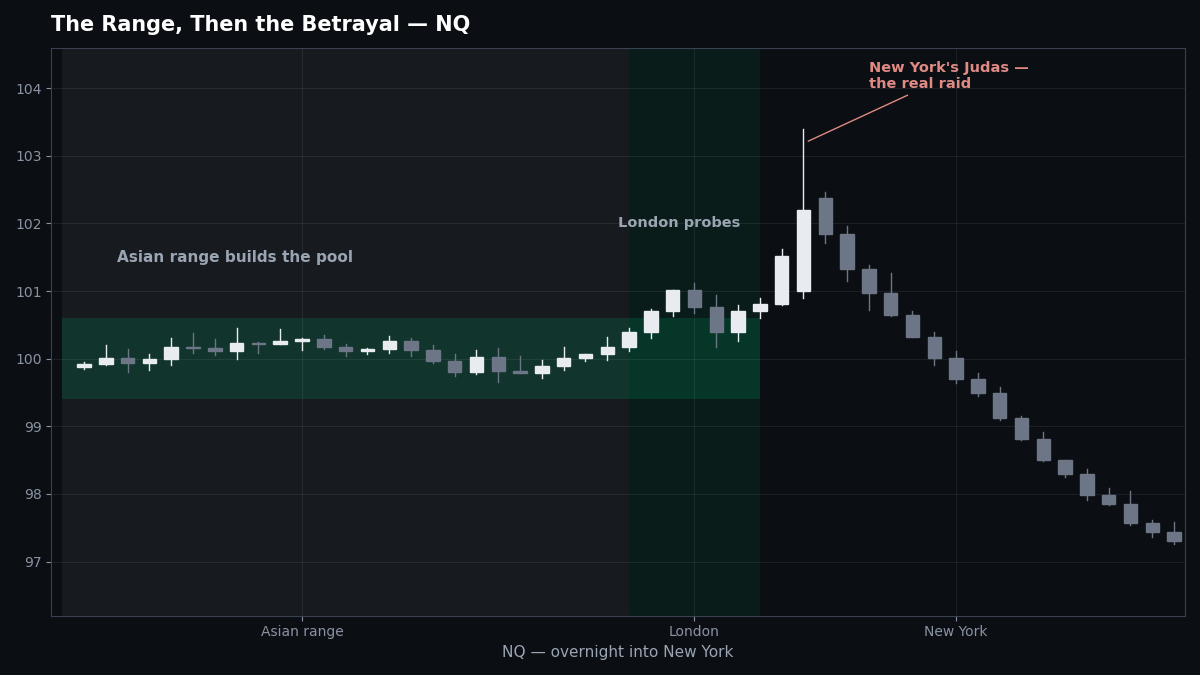
A Judas swing in ICT is the false move at the start of a session — a deliberate push in the wrong direction that sweeps the liquidity resting beyond a range, traps traders who chased it, and then reverses into the session’s real delivery. It is named for the betrayal: the move looks like a breakout and behaves like a friend, right up until it hands your position to the other side. On NQ it appears most often at the New York open, when price runs the overnight high or low in the first minutes — and, slightly less often, at the London open against the Asian range. The Judas swing is the manipulation phase of the Power of Three, arriving on schedule at the open of a killzone.
What is a Judas swing?
Start with what the session needs. By the time New York opens, a range exists — the overnight range, capped by the Asian and London extremes — and stops rest beyond both ends of it. The algorithm’s efficient route is to collect one side’s stops first, because those orders are the fuel and the fill for the day’s real position. The Judas swing is that collection, dressed as a breakout: price pushes through the overnight high with urgency, breakout buyers enter, shorts stop out — and now the large sell position the morning was actually about has been filled at the best prices of the day, by the very traders who thought they were joining a rally.
Then the tells: the push stalls within minutes. It cannot displace above the range — candles shrink, a wick reaches back inside, and on the 1-minute and 5-minute charts a market structure shift prints against the opening move, with displacement and a fair value gap. The session’s real direction declares itself, and price delivers — usually through the range, usually to the liquidity pool on the far side, which was the draw all along.
Two features separate a Judas swing from an ordinary failed breakout. Timing: it happens at or immediately after a session open — the London open against the Asian range, the New York open (the 8:30 data or the 9:30 cash open) against the overnight range. A “false move” at 1:15 p.m. is just chop. Purpose: it runs a known pool — the overnight extreme, equal highs or lows, yesterday’s high or low. The move has a destination it reaches and rejects, not a random direction it wanders into.
How a Judas swing forms
The formation, step by step, in its classic bearish form at the New York open:
- The range is set. Overnight, price builds a range. Its high — often equal highs, often the London high as well — carries buy-side liquidity above it: breakout buy-stops and the stops of anyone short the range.
- The open pushes the wrong way. The 8:30 data or the 9:30 cash open drives price through the overnight high. Urgency is part of the design: the move must be fast enough to trigger the stops and pull in chasers before doubt sets in.
- The extreme prints. The Judas push usually makes the session’s high (or low, in the bullish form) within the first minutes of the window. It overshoots the pool by a little — enough to fill the orders, not enough to start a trend.
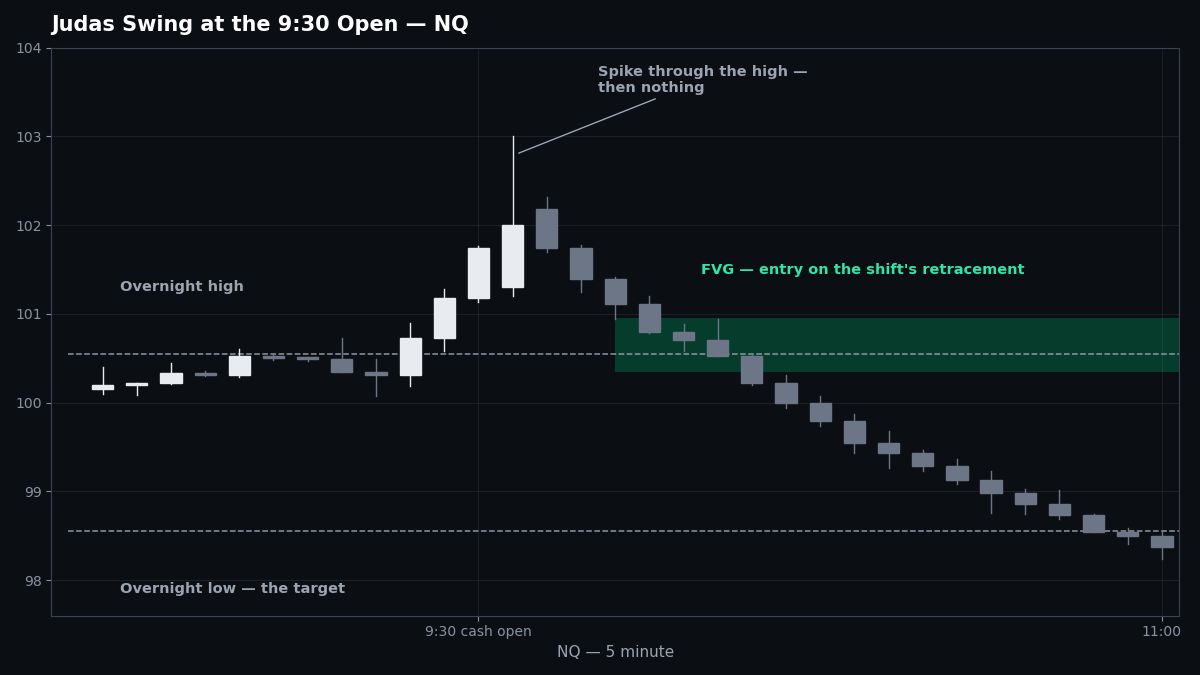
- The shift betrays it. Price falls back inside the range and breaks structure downward with displacement. That MSS is the moment the Judas swing is confirmed — before it, you have a breakout; after it, you have a trap that has sprung.
- Delivery runs the other way. The session’s real move delivers toward the sell-side pool below — the overnight low, yesterday’s low, the draw that was named before the open.
How do you identify a Judas swing?
You do not identify it in advance — you identify the conditions in advance and the swing itself in its first minutes:
- A range with an obvious pool beyond it. Overnight or Asian range extremes, equal highs or lows near the open, yesterday’s high or low within reach. No pool, no Judas.
- A directional expectation for the day. From the higher-timeframe dealing range: if price sits in premium of the daily range with sell-side resting below, the open’s upward push is the suspect one. The Judas swings against the day’s draw.
- The open’s first move runs the near pool aggressively — and then fails to hold beyond it. A push that accepts above the pool with displacement and closing strength is not a Judas; it is expansion, and the framework treats it completely differently.
- The shift confirms. Until an MSS prints against the opening move, the Judas is a hypothesis. The shift — lower-timeframe, with a gap — is what turns suspicion into a tradeable read.
How do you trade the Judas swing on NQ?
You trade the response to it, never the swing itself:
- Do not chase the open’s first move. The first minutes after 9:30 are the trap being set. Whatever your bias, the open’s urgent push through a range extreme is the last place in the session to take an entry at market.
- Wait for the shift, enter on its retracement. After the MSS against the Judas push, enter on the return into the fair value gap (or the order block at the shift’s base), in the direction of the day’s draw. Stop beyond the Judas extreme — that high or low is the manipulation’s full extent, and price returning through it ends the read.
- Target the far pool. The Judas collected one side; delivery aims at the other. The overnight low, the session’s opposing extreme, yesterday’s low — the pool opposite the raid is the objective, and it was identifiable before the open.
- Size for the morning, not the moment. The Judas trade is a New York AM killzone trade. It belongs to the window; if the shift never prints inside the window, the idea expires with it.
The bullish form is the mirror: the open dumps through the overnight low — a data-release flush or a 9:30 drive into sell-side — stalls, shifts up with displacement, and the real day delivers upward to the buy-side pool. Same betrayal, opposite sign. On NQ the bullish Judas after a sell-side raid is one of the highest-quality long triggers the framework offers, because the trap it springs is full of freshly stopped-out shorts and late sellers.
Common mistakes
- Shorting the push because “it’s obviously a Judas.” Nothing about the push is obvious while it is pushing. Some opens run a pool and keep going — continuation, not betrayal. The Judas is confirmed by the shift after the stall, and trading it before the shift is just fading momentum with an ICT label.
- Entering during the manipulation. The Judas minutes are the session’s worst prices for the day’s real direction. Every part of the model — the shift, the gap, the retracement — exists to keep you out of those minutes and in after them.
- Seeing a Judas in every open. If there is no range, no resting pool and no higher-timeframe draw, an opening push is just an opening push. The Judas needs its stage set: range, pool, and a reason for the day to go the other way.
- Forgetting London already did it. When London’s open already ran the Asian range and reversed, New York’s “Judas” in the same direction is often just continuation of London’s distribution. Check which session’s manipulation you are actually looking at before doubling the story.
- Using the Judas swing outside its windows. The concept is welded to session opens — London against Asia, New York against the overnight range. A midday fake-out is a liquidity sweep inside chop; grading it as a Judas swing imports a confidence the clock never gave it.
FAQ
What is a Judas swing in ICT?
The false opening move of a session: a push through a range extreme that sweeps the liquidity resting there, traps breakout traders, and reverses into the session’s real move. It is the manipulation phase of the Power of Three, timed to a session open.
Why is it called a Judas swing?
For the betrayal. The move presents itself as a genuine breakout — the start of the session’s trend — and is actually the opposite: the mechanism that fills the real position at the expense of the traders who trusted it.
When does a Judas swing happen on NQ?
At the session opens inside the killzones: the London open (2:00–5:00 a.m. ET) against the Asian range, and the New York open — the 8:30 a.m. data or the 9:30 a.m. cash open — against the overnight range.
How is a Judas swing different from a liquidity sweep?
A liquidity sweep is the general event: any raid of a pool. A Judas swing is a specific, timed sweep — the opening move of a session, against the day’s draw, engineered as the manipulation phase before the real delivery. Every Judas swing is a sweep; most sweeps are not Judas swings.
How do you know a Judas swing is confirmed?
The push stalls at the pool, price falls back inside the range, and a market structure shift prints against the opening move with displacement and a fair value gap. Before the shift, it is a suspicion. After it, it is the setup.
Do you trade the Judas swing itself?
No — you trade the response: the shift’s retracement into its gap or block, toward the far pool, with the Judas extreme as invalidation. Entering during the opening push means entering inside the trap.
Where to go next
The Judas swing is the middle act of the Power of Three — that page gives the full three-phase shape it belongs to. The clock it runs on is in ICT killzones, and the model that trades the delivery after it, step by step, is the ICT 2022 Model. The full map is in the ICT section hub.