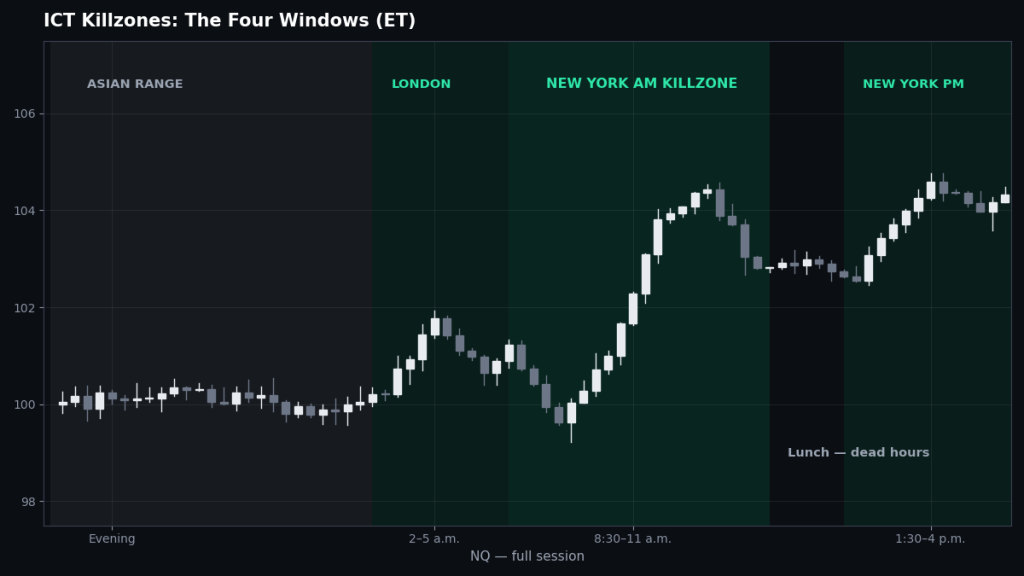
ICT killzones are the specific time windows in each trading day when the algorithm does its real delivery — when liquidity gets raided, structure shifts, and the session’s main move forms. ICT names four that matter on futures: the Asian session, which quietly builds the overnight range; the London killzone (2:00–5:00 a.m. ET), which often makes the first raid; the New York AM killzone (8:30–11:00 a.m. ET), where NQ’s main move usually happens; and the New York PM killzone (1:30–4:00 p.m. ET), the afternoon window. Between the windows sit the dead hours, where the same patterns mean far less. In ICT, when is half the trade: a fair value gap at 9:45 a.m. and the identical gap at 12:45 p.m. are different animals.
What are ICT killzones?
Everything in Weeks 1 and 2 of this section — structure, liquidity, PD arrays — describes where price reacts. Killzones are the missing half: when. Price delivery is not spread evenly across the day. It concentrates around session opens, session overlaps, and the scheduled data releases, because that is when the order flow the algorithm needs actually shows up. The rest of the time, price mostly drifts, builds ranges, and manufactures the liquidity the next window will consume.
That gives every window a job, and the jobs repeat so reliably that an ICT trader can plan the day around them:
| Window (ET) | Name | Its job on NQ |
|---|---|---|
| ~6:00 p.m.–12:00 a.m. | Asian session | Builds the Asian range — the overnight reference highs and lows |
| 2:00–5:00 a.m. | London killzone | First real volume; often raids one side of the Asian range |
| 8:30–11:00 a.m. | New York AM killzone | The main event: data at 8:30, cash open at 9:30, the day’s main delivery |
| 1:30–4:00 p.m. | New York PM killzone | The afternoon window, after the lunch lull; second moves and late reversals |
A fifth window gets an honourable mention: the London Close (10:00 a.m.–12:00 p.m. ET), when London traders square up and New York mornings often print their high or low of the day before fading. You do not need to trade all of these. Most NQ traders need exactly one — New York AM — and need to understand the others only because they build the map that New York AM trades against.
The four windows
The Asian session: the range gets built
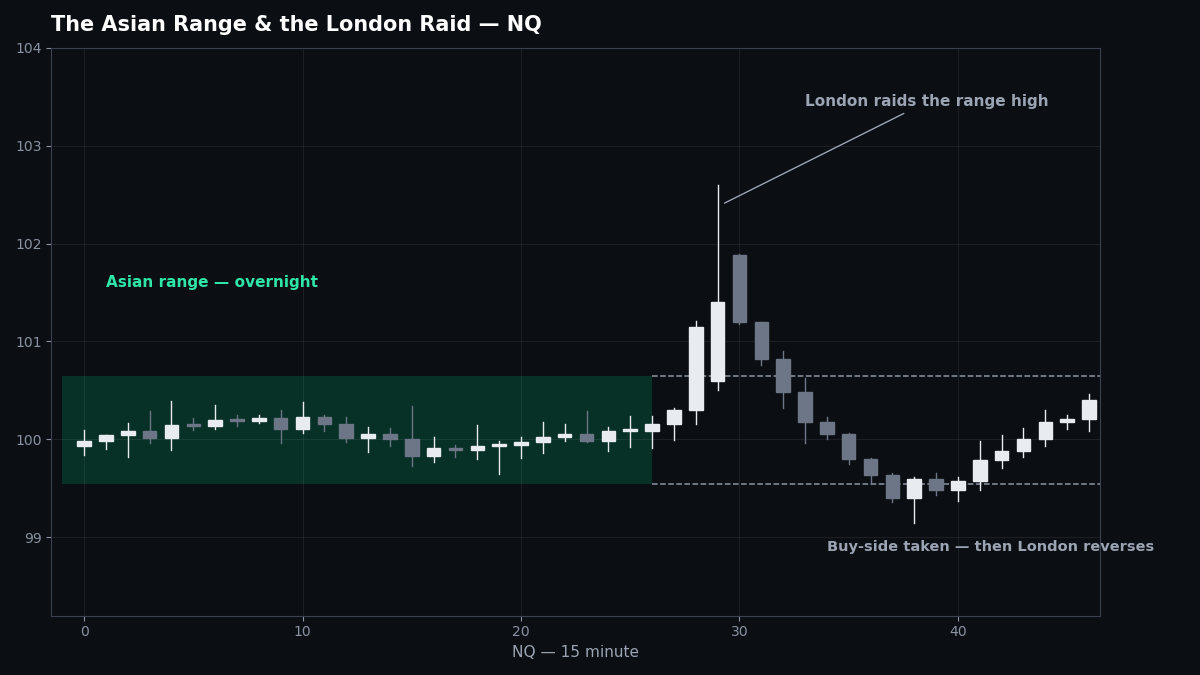
The futures day opens at 5:00 p.m. ET, and the evening session that follows is the quietest stretch of the 24-hour cycle. Price typically compresses into a narrow range — the Asian range — with a clean high and a clean low. Almost nothing about the Asian session is tradeable for a New York-hours trader, and that is fine, because its real product is reference points: the Asian range high and low are standing pools of liquidity, and the day’s later windows will raid one of them before doing anything important. Mark the Asian range extremes before you sleep or before the morning, every day. They are the first lines on the chart.
The London killzone: the first raid
London’s open (2:00–5:00 a.m. ET) brings the first real volume of the day. London’s classic behaviour is to push price out of the Asian range — frequently a Judas swing, a false move that sweeps the Asian range high or low, traps early traders, and reverses. Sometimes London instead delivers a genuine expansion and hands New York a trend to continue. Either way, London writes the morning’s first draft: it takes a pool, shows displacement (or doesn’t), and leaves New York a range — the Asian-plus-London extremes — that the cash session will respect or raid at the open.
The New York AM killzone: the main event
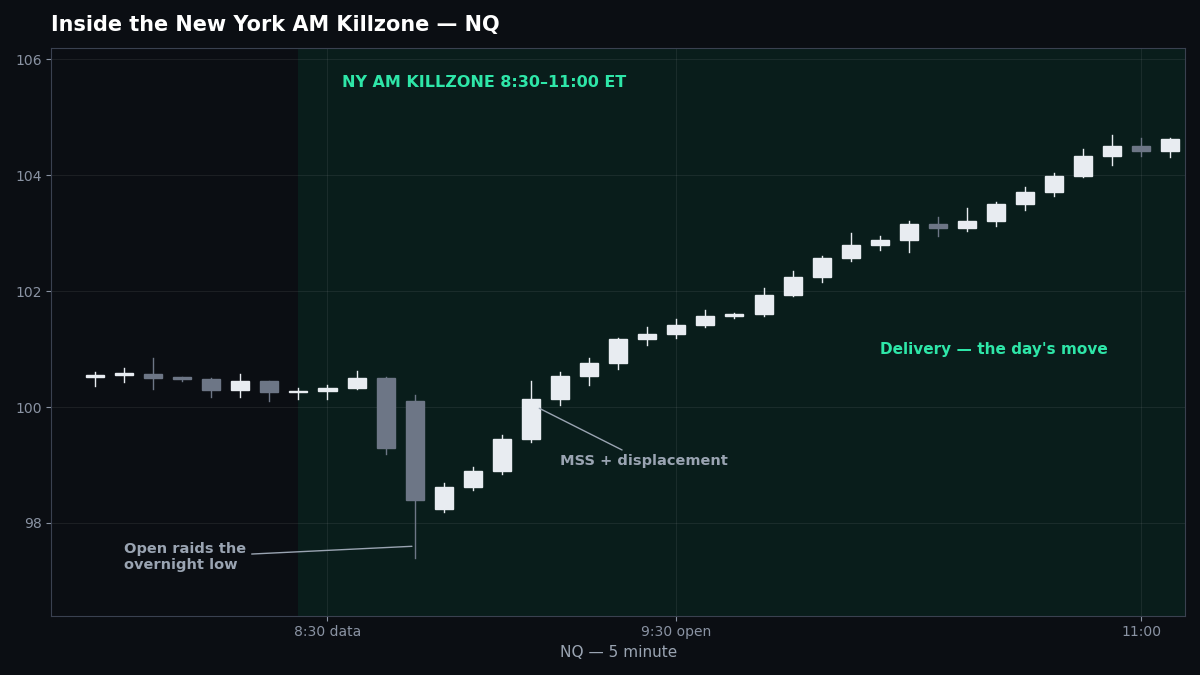
For an NQ trader, this is the window the whole framework revolves around: 8:30–11:00 a.m. ET. Two triggers live inside it. The 8:30 a.m. data releases (CPI, employment, GDP and their cousins) deliver the first displacement of the cash day. The 9:30 a.m. cash open delivers the second — often a raid of the overnight or London extreme, followed by the market structure shift that starts the real move. The day’s high or low prints inside this window on most days worth trading, and the models in this week’s batch — the ICT 2022 Model and the Silver Bullet — are both built to run here. If you can only be sharp for one stretch of the day, be sharp for this one.
The New York PM killzone: the second act
After the AM window closes, lunch (roughly 11:30 a.m.–1:30 p.m. ET) is the day’s deadest stretch — thin, choppy, and famous for taking back morning profits from traders who keep pressing. The PM killzone (1:30–4:00 p.m. ET) is the afternoon’s delivery window: second legs of the morning’s move, late reversals after the AM high or low gets raided, and the PM Silver Bullet hour at 2:00–3:00 p.m. PM moves are real but less reliable than AM moves on NQ — size and expectations should both be smaller.
How do you identify a killzone setup?
A killzone is identified by the clock first and by price second. The working checklist:
- Know which window you are in — or that you are in none. No window, no model. This single rule deletes most bad trades.
- Mark what the previous windows built. Asian range extremes, London high and low, yesterday’s high and low. Those are the pools this window will work with.
- Watch the window’s opening minutes for the raid. The killzone’s signature start is a sweep of a nearby pool in the first minutes — the Judas push — not a slow grind.
- Demand displacement inside the window. A structure shift with a fair value gap during the window is delivery. The same shift at 12:40 p.m. is a rumour.
- Check the calendar. On CPI, FOMC and nonfarm payroll days the windows still apply, but the 8:30 release is the killzone’s first act — many traders stand aside for the print and trade the shift that follows it.
How do you trade killzones on NQ?
Killzones are a schedule, not a signal. They tell you when to be willing. The working routine:
- Prepare before the window, not during it. Pools marked, bias set from the higher-timeframe dealing range, the day’s data releases noted. Preparation is what the dead hours are for.
- Trade your model only inside its window. The 2022 Model in New York AM. The Silver Bullet in its three one-hour windows. Outside the window, the model is closed — no matter how good the chart looks.
- Let the window come to you. The raid and the shift happen on the algorithm’s schedule. Staring at the 1-minute chart from 6:00 a.m. “so you don’t miss it” mostly manufactures early, tired, emotional entries.
- Stop when the window closes. An AM trade still open at 11:00 is a management problem, not a new opportunity. The PM window is a separate decision, made fresh, at smaller size.
- Journal the window, not just the trade. Most traders who “have an ICT problem” discover, three months into a journal, that they actually have a 12:30 p.m. problem. The fix is a clock, not a new concept.
Common mistakes
- Trading the lunch chop. 11:30 a.m.–1:30 p.m. ET is where morning profits go to be refunded. Thin delivery, false breaks, ranges inside ranges. The killzone framework exists largely to keep you out of exactly this.
- Treating every hour as equal. A setup is its context plus its clock. If your journal cannot tell a 9:45 a.m. entry from a 1:45 p.m. entry, it is hiding your biggest leak.
- Forcing trades in the Asian session. The Asian range is a reference, not an arena. Its job is to be raided later. Trading inside it means paying spreads to watch paint dry.
- Ignoring the data calendar. An 8:30 CPI print rewrites the morning in one candle. Entering a killzone model blind on a red-folder day is not discipline; it is volunteering.
- Chasing London’s move in New York. London’s expansion is often the manipulation, not the move. New York AM regularly delivers against the London direction — read the raid at the cash open before assuming continuation.
- Mixing up time zones. Every time in ICT is Eastern. During the weeks when US and European daylight-saving changes fall out of sync, London’s window effectively shifts — check the clock before you blame the concept.
FAQ
What are the ICT killzone times in Eastern Time?
London 2:00–5:00 a.m., New York AM 8:30–11:00 a.m., New York PM 1:30–4:00 p.m., with the Asian session building its range in the evening after the 5:00 p.m. ET futures open. The London Close (10:00 a.m.–12:00 p.m.) is a secondary window.
Which killzone is best for trading NQ?
New York AM, and it is not close. It contains the 8:30 data releases and the 9:30 cash open, produces the day’s main displacement, and is the window the 2022 Model and the AM Silver Bullet are built for.
What is the Asian range in ICT?
The narrow high-to-low range price builds during the quiet evening (Asian) session after the futures open. Its extremes are reference liquidity pools that London and New York later raid — you mark the Asian range to use it, not to trade inside it.
Do killzones work on futures, or only forex?
They work on futures — arguably more cleanly, because NQ trades on one central feed with hard session events: the 5:00 p.m. open, the 8:30 data, the 9:30 cash open, the 4:00 p.m. close. The windows are anchored to those events, not to forex session conventions.
What should I do outside the killzones?
Prepare, manage, or stand aside. Mark levels, set the bias, review the journal. The dead hours are for homework; the windows are for execution. Trading in between is how a time-based framework gets traded without the time part.
Does London matter if I only trade New York hours?
Yes — London writes the map your window trades against. The London high and low and the Asian range extremes are the pools the New York open most often raids. You do not have to trade London, but you do have to have marked it.
Where to go next
Killzones are the clock; the models are what run on it. The Silver Bullet is the purest killzone model — one hour, one setup. The ICT 2022 Model is the full sequence the New York AM window usually delivers, and the Power of Three is the shape every window draws. All of it sits on the foundations — liquidity tells you what the windows are hunting — and the full map is in the ICT section hub.