The ICT optimal trade entry (OTE) is a Fibonacci retracement zone — between the 61.8% and 79% levels of a price leg, with 70.5% as its sweet spot — where ICT traders enter in the direction of a move after it has already begun. Turtle Soup is the opposite kind of precision: a reversal entry built on a failed breakout, where price raids an old high or low — the pool the original “turtle” breakout traders were buying or selling — and immediately reverses. One model buys the dip at a measured depth; the other fades the raid at a measured extreme. Both are on this page because they share a job: they are ICT’s two precision entries, the ones you use when the framework has given you a direction and you need the exact place to act on it.
What is the optimal trade entry (OTE)?
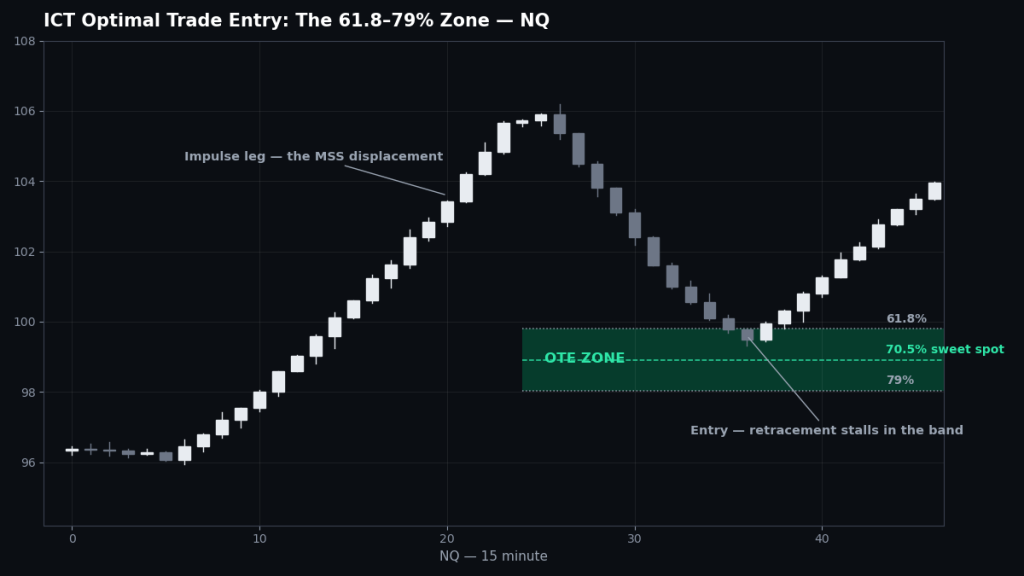
After a market structure shift, price rarely continues in a straight line. The impulse leg that printed the shift retraces — gives back a portion of itself — before the real continuation. The optimal trade entry names the depth of retracement where that continuation most reliably resumes: the band between the 61.8% and 79% Fibonacci levels of the impulse leg, with the 70.5% level — the band’s heart — called the sweet spot.
You draw it in seconds: anchor a Fibonacci retracement on the impulse leg (for a bullish leg, from the swing low where the displacement began to the swing high where it stalled), and the OTE zone is the shaded band deep in the leg’s lower portion. For a long, that geometry has a second virtue: the 61.8–79% band of a fresh bullish leg almost always sits inside discount of the leg’s own range — premium/discount logic and Fibonacci logic arriving at the same prices from different directions. ICT traders rarely take OTE alone; the high-grade version is OTE plus an array inside it — a fair value gap or an order block sitting in the band is the entry, with the band as its frame.
What is Turtle Soup?
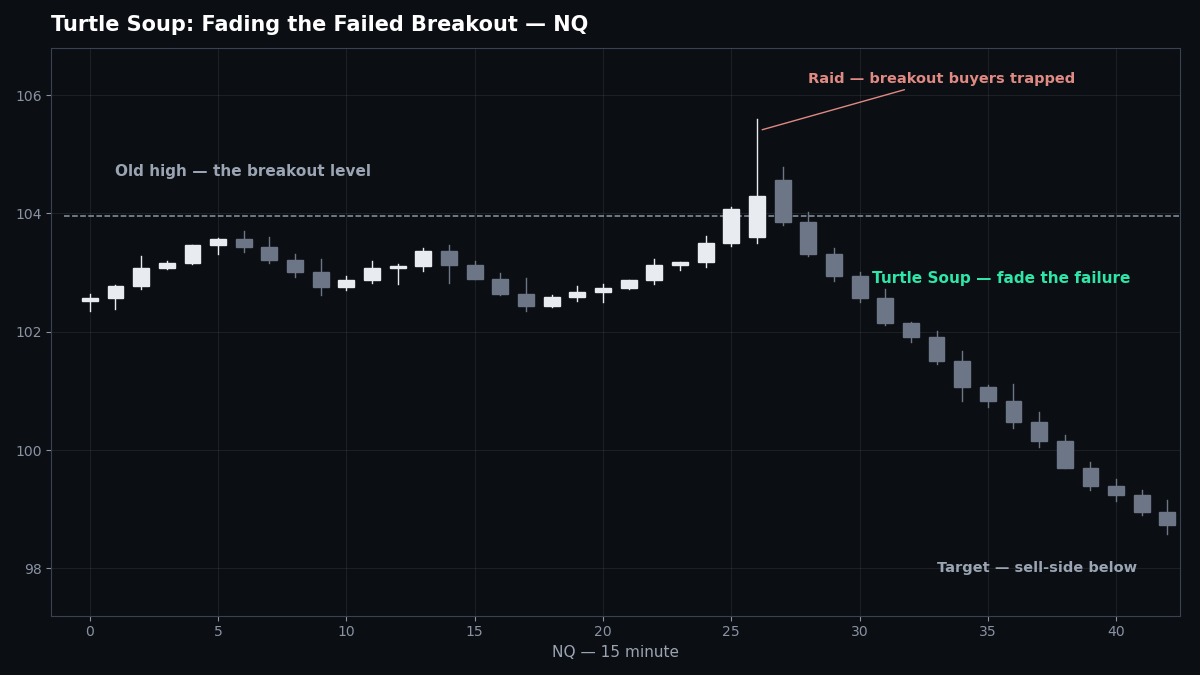
Turtle Soup predates ICT — it comes from Linda Bradford Raschke’s work, fading the breakout entries of the famous Turtle traders, who bought 20-day breakouts and sold 20-day breakdowns. ICT adopted and renamed the logic because it is, mechanically, a liquidity raid with a rulebook: when price pushes through an old high or low — a swing from days or weeks back, the kind of level breakout systems key on — and immediately fails to hold beyond it, the breakout traders are trapped on the wrong side and their stops become the fuel for the reversal. The Turtle Soup entry is that fade: sell the failed breakout of the old high, buy the failed breakdown of the old low, stop beyond the raid extreme.
ICT’s common variant, Turtle Soup Plus One, waits one extra beat: instead of fading the first poke through the level, it lets the raid complete and enters on the first lower-timeframe shift or retracement after the failure — the conservative version, trading a little price for a lot of confirmation. If Turtle Soup sounds familiar after the last few pages, it should: it is the Judas swing’s logic at a higher timeframe and an older level — the same raid-and-reverse, keyed on the pools that form at multi-day extremes instead of session ranges.
How do you identify an OTE or a Turtle Soup?
For an optimal trade entry:
- You need a leg worth measuring. OTE is drawn on the impulse that shifted structure — a displacement leg with a clear swing low and swing high. Measuring a choppy, overlapping drift produces a precise zone around a meaningless move.
- Anchor the fib on the leg’s extremes — wick to wick, in the direction of the leg. Mark 61.8%, 70.5% and 79%. The band between the outer two is the zone.
- Check the band against the map. The zone should agree with the dealing range: deep in discount for a long, deep in premium for a short. A band that lands at equilibrium of the larger range is a weaker OTE.
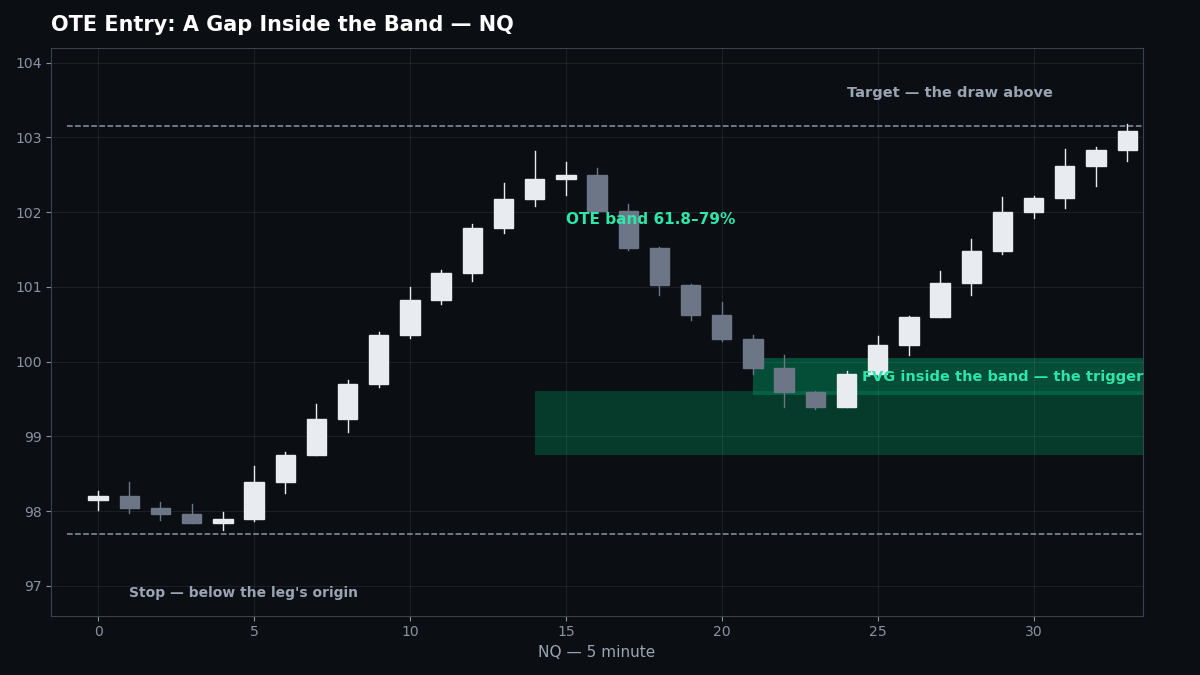
- Look for the array inside the band. A gap or block inside the OTE zone is the actual trigger level. The band narrows where; the array times when.
For a Turtle Soup:
- Find the old extreme. A prominent high or low from a prior day or week — ideally a level breakout traders are watching, with equal highs or lows making the pool even more obvious.
- Wait for the raid and the failure. Price trades through the level — and closes back inside, or wicks through and stalls. Acceptance beyond the level with displacement is not a Turtle Soup; it is a genuine breakout, and fading it is the model’s losing trade.
- Enter on the failure’s confirmation — the lower-timeframe shift back inside the level (Plus One style), stop beyond the raid extreme. The stop is usually tight, which is half the model’s appeal.
How do you trade them on NQ?
They serve different days, and choosing between them is a read of what the market has offered:
- OTE is the continuation entry. The day has shifted, the direction is set, and you missed (or skipped) the first entry at the gap. The retracement into the 61.8–79% band is the market’s second invitation, at a better price than the shift’s close. On NQ, the classic run: a bullish MSS in the New York AM killzone, a displacement leg up, then a late-morning retracement into the band — where the entry fills, with the stop below the leg’s origin and the target at the draw above.
- Turtle Soup is the reversal entry. The day (or week) has run to an old, obvious extreme — and the raid of it, at the right time of day, is the setup. Its natural home is the raid at a killzone open: the 9:30 push through yesterday’s high that fails is a Turtle Soup wearing Judas clothing, and the two pages describe one event from two distances.
Both models share the same risk discipline: the invalidation is mechanical (below the leg’s origin for OTE; beyond the raid extreme for Turtle Soup), the target is the draw on liquidity named before entry, and neither model is a reason to trade against the higher-timeframe frame. Precision entries amplify a good read; they do not rescue a bad one.
Common mistakes
- Drawing OTE on the wrong leg. The fib belongs on the impulse that shifted structure — the displacement leg — not on the nearest convenient swing. Anchor it on chop inside the range and the band will sit at prices that mean nothing.
- Taking the band without the trigger. Price reaching 70.5% is geography, not a signal. The high-grade OTE waits for the array inside the band, or a lower-timeframe shift off it. Entering because “the fib says so” is how a precision model becomes a coin flip with decimals.
- Fading every old-high breakout as Turtle Soup. Breakouts sometimes hold. The model requires the failure: no hold beyond the level, a shift back inside. Fading a raid while price is displacing through the level is standing in front of the continuation the pool was funding.
- Using OTE to chase a move that never retraced. If price runs from the shift without giving back 61.8%, there was no OTE — there was a move you were not on. Stretching the fib to a later leg to manufacture a band is journal fraud, not analysis.
- Forgetting which model the day is offering. Continuation days give OTEs; raid-and-reverse days give Turtle Soups. Trying to fade the morning’s raid (Turtle Soup) on a day that has already shifted and is distributing (an OTE day) means trading yesterday’s story at today’s prices.
FAQ
What is the optimal trade entry in ICT?
A Fibonacci retracement entry zone between the 61.8% and 79% levels of an impulse leg — with 70.5% as the sweet spot — used to enter in the direction of a move after a structure shift, ideally where a fair value gap or order block sits inside the band.
What Fibonacci levels matter for OTE?
61.8%, 70.5% and 79% — the zone is the band between the first and last, and 70.5% is the level ICT traders weight most. The band is drawn wick to wick across the displacement leg that shifted structure.
What is Turtle Soup in trading?
A fade of a failed breakout of an old high or low: price raids the level breakout traders key on, fails to hold beyond it, and reverses. ICT’s version treats the raid as a liquidity grab, with the stop beyond the raid extreme and the target at the opposing pool.
What is Turtle Soup Plus One?
The conservative variant: instead of fading the first poke through the old level, you wait for the raid to complete and enter on the first confirmation — a lower-timeframe structure shift back inside the level — trading a little price for confirmation.
Is OTE a standalone strategy?
No. OTE is an entry location inside the framework: the shift gives the direction, premium/discount and the draw give the context, and OTE prices the retracement. Used alone, a fib band is just lines; used after a shift, it is one of ICT’s most reliable entry zones.
Which is better, OTE or Turtle Soup?
They answer different questions. OTE enters a move that has already turned, on its retracement. Turtle Soup enters against a move that has just failed, at its extreme. The day decides which one it is offering — your job is to recognise which, not to have a favourite.
Where to go next
OTE’s parent sequence — the shift it retraces — is the ICT 2022 Model, and the band’s logic is premium and discount with a Fibonacci ruler. Turtle Soup’s session-scale sibling is the Judas swing. The full map is in the ICT section hub.