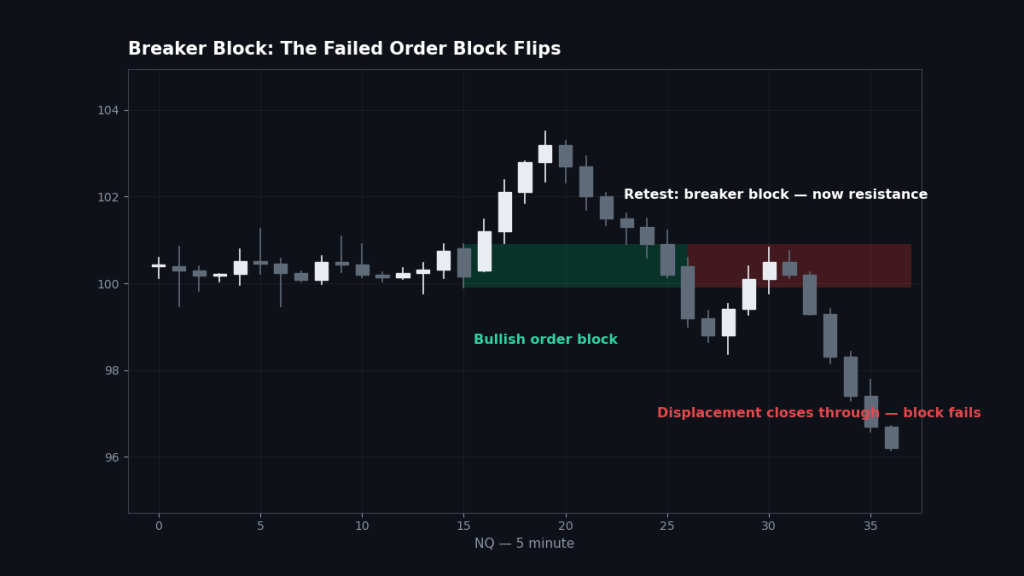
A breaker block in ICT is an order block that failed. When price closes through a bullish order block instead of respecting it, that zone does not stop mattering — it flips sides: the same prices that were support become resistance, and the retest of the broken block is one of the cleanest entries in the framework. A mitigation block is its close cousin: the order block price returns to after a break in structure, where positions from the old move are offset — mitigated — before price continues in the new direction. Both blocks are born from failure, and both exist for the same reason: traders who entered on the original block are trapped, and their exits become the fuel for the move that runs them over.
What is a breaker block?
Work backwards from an ordinary order block. A bullish order block — the last down candle before an upward displacement — is supposed to hold as support when price returns. Sometimes it does not. Price comes back into the block, trades through it, and closes beneath its low. The buyers who entered there are now underwater, sitting on longs whose break-even price is exactly the zone price just fell through.
ICT’s insight is what happens next. When price later rallies back up into that same zone, those trapped buyers sell to get out at break-even — and their selling, added to fresh sellers who read the flip correctly, turns the old support into real resistance. That flipped zone is the breaker block: a failed order block, retested from the opposite side, now working against its original direction. A bearish order block that price closes above becomes a bullish breaker in mirror image — old resistance, now support on the retest.
Two conditions make a breaker high-quality rather than just “a level that broke”:
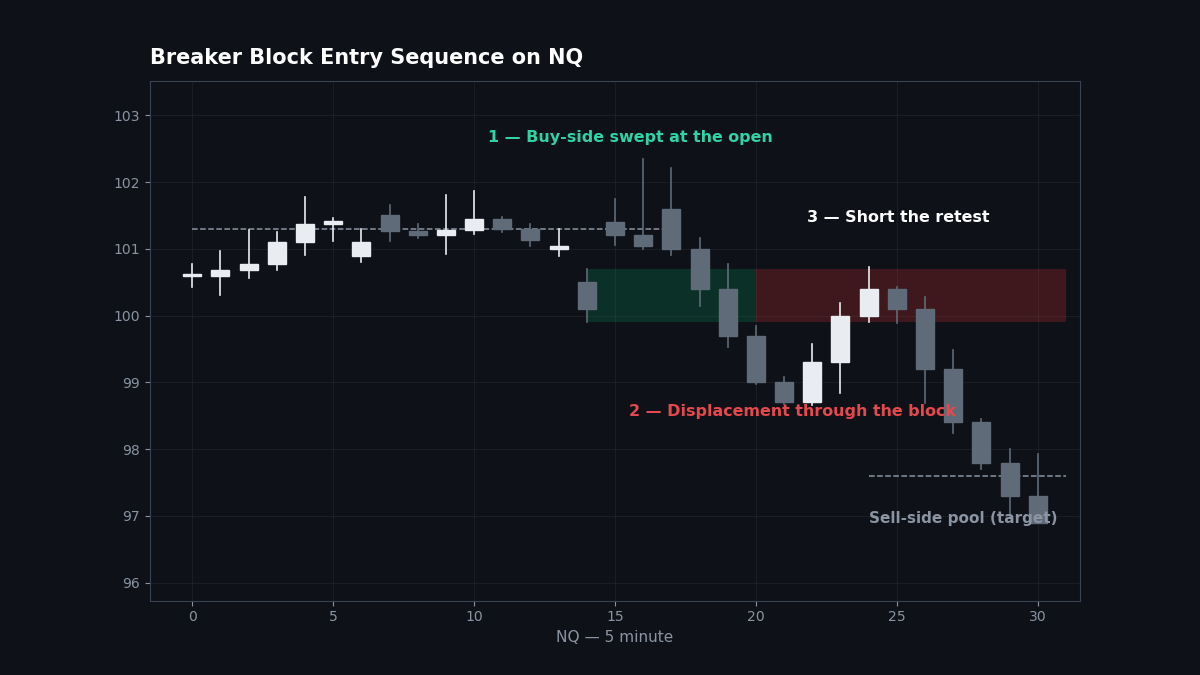
- A liquidity raid precedes the failure. The classic breaker forms when price first sweeps a pool — runs the highs, traps breakout buyers and late longs — then breaks down through the order block below. The raid loads the trap; the break springs it.
- The break is decisive. A wick into the block that closes back inside is a retest, not a failure. The breaker is confirmed by displacement through the block: bodies closing beyond it, ideally leaving a fair value gap on the way. Half-hearted breaks make half-hearted breakers.
What is a mitigation block?
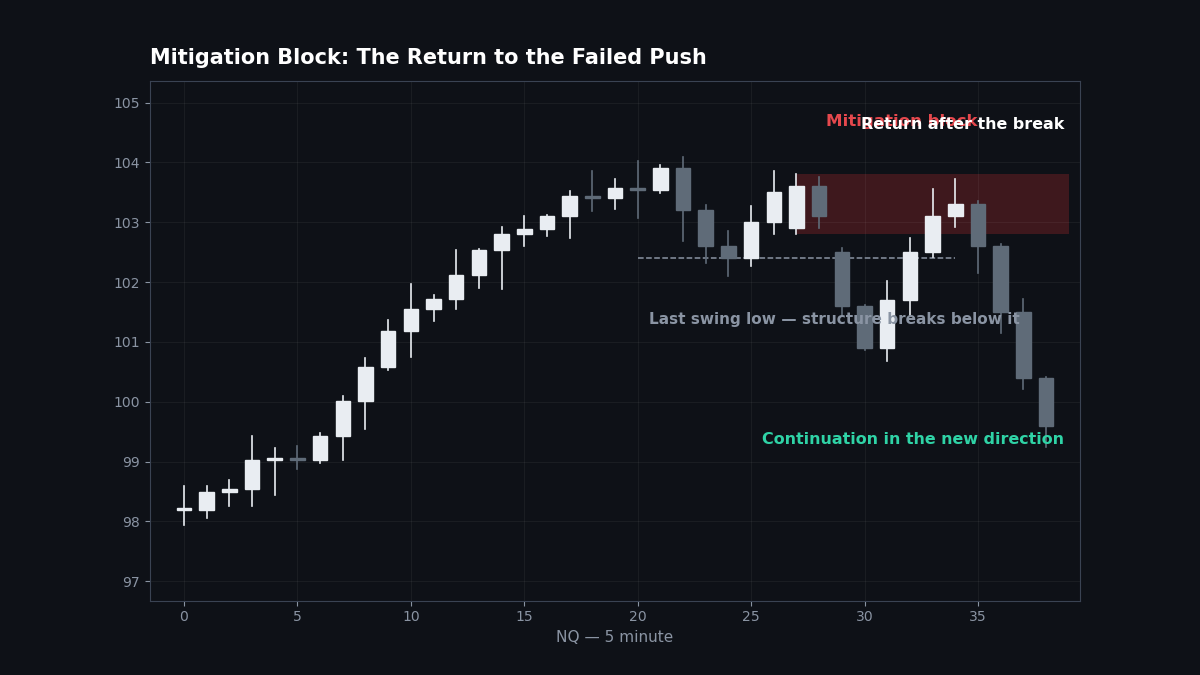
A mitigation block is the order block that price returns to after market structure has already broken, so that the losing side can mitigate — offset or close out — the positions opened during the old move. The picture: price trends up and makes a final swing high that fails to extend. Structure then breaks down — a lower low, a market structure shift. On the first real pullback, price climbs back into the candles that launched the last, failed push up. That zone is the mitigation block. The longs built there are not being defended; they are being unwound, and the unwinding supplies the selling that caps the pullback. Price then continues in the new, bearish direction.
The difference from a breaker is which side of the failure you are looking at:
- Breaker: price closes through the block. The block changes sides — support becomes resistance — and the trade is the retest from the other side.
- Mitigation: price breaks structure first, then returns into the block of the failed move without needing to close through it. The block is visited so positions can be closed, and the trade is the continuation out of it.
In practice the two often appear in the same sequence — a failed high (mitigation block on the retest up) inside a larger move that also breaks a block below (breaker on the retest up). You do not need to win the taxonomy argument. You need to know that after a genuine shift, the candles of the old move are not support or resistance in their original sense anymore — they are exit doors, and price returning to them is an entry opportunity in the new direction.
How do you identify breaker and mitigation blocks?
For a breaker block:
- Mark a valid order block first — displacement, structure break, correct location; the breaker inherits all of the original block’s quality rules.
- Watch the return trip fail. Price re-enters the block and closes through its far edge with displacement. A close beyond the block’s extreme is the confirmation; wicks do not flip blocks.
- Redraw the same zone with the opposite expectation. The zone does not move. Only its job changes. Note the block’s mean threshold too — retests of a breaker often turn near it.
- Grade the raid. If the failure followed a sweep of an obvious pool — equal highs taken before the block broke — the trap is loaded and the breaker grades higher.
For a mitigation block:
- Find the failed swing. The last push that made a lower high in an uptrend (or a higher low in a downtrend) and then gave way to a break of structure against it.
- Mark the candle base of that push. The opposing candles at the origin of the failed push are the mitigation block — same drawing rules as any order block: full range, high to low.
- Wait for the return after the break. The mitigation retest happens after structure has shifted, on the first pullback into the zone — not before, and not on the third visit.
How do you trade breakers and mitigation blocks on NQ?
Both blocks trade the same way: as retest entries in the new direction, after the old one has demonstrably died. The working method:
- Let the failure happen. No anticipating. A bullish block is not a short until price has closed through it (breaker) or structure has shifted and price is returning to the old move’s origin (mitigation).
- Enter on the retest. Price comes back to the flipped zone. Refine with the block’s mean threshold, or drop to the 1-minute chart inside the zone and wait for a small shift with a fair value gap confirming the turn. Stop beyond the zone’s far edge — beyond the original block’s extreme, not inside it.
- Target the draw in the new direction. The breaker trade aims at the liquidity the new move is working toward — usually the pool that was sitting beyond the failed block all along. The failure was the algorithm changing its mind about the route, not about the destination.
- Respect the clock and the location. A breaker that forms in premium after buy-side is swept, inside the New York AM killzone, is the framework working at full strength. A breaker in the middle of a range at 1:30 p.m. is a coin flip with better branding.
A concrete NQ morning: pre-market, price pushes to a new high on a compact base — a bullish order block forms underneath at the last down candle. At 9:30 the cash open spikes through the overnight high, sweeping buy-side, then collapses: displacement down, straight through the block, closing beneath it. At 10:05 price retraces up into the underside of that same zone — the breaker — taps its mean threshold, and rolls over. The short targets the overnight low, the sell-side pool. Everyone who bought the block is now the exit liquidity that made the retest work.
Common mistakes
- Flipping a block on a wick. A probe into a block that closes back inside is a successful retest, not a failure. Breakers are confirmed by closes through the zone with displacement — treat anything less as the original block still doing its job.
- Trading the break itself at market. Chasing the displacement candle through the block means entering at the worst price of the move with the retest still to come. The breaker’s edge lives in the retest. If price never comes back, the trade was never yours.
- Calling every return to an old candle a mitigation block. The mitigation block requires the sequence: failed swing, break of structure, then the return. Price drifting back into old candles inside an intact trend is just a pullback to an order block — different concept, different expectation.
- Forgetting whose money is trapped. The breaker works because specific traders are underwater at specific prices. If the original block was obscure, untested and formed in dead hours, nobody is trapped in it — and the flipped zone has no fuel. Grade breakers by how obvious and how used the original block was.
- Using breakers against a higher-timeframe draw. A 5-minute breaker shorting into a daily bullish draw on liquidity is a scalp into a freight train. The flip changes the local read; it does not rewrite the higher-timeframe map from liquidity and market structure.
FAQ
What is a breaker block in ICT?
A breaker block is a failed order block. When price closes through a bullish order block, the zone flips: on the retest it acts as resistance, because the buyers trapped there exit at break-even into the rally. A failed bearish block flips into support the same way.
What is the difference between a breaker block and a mitigation block?
A breaker is created by price closing through the block itself, flipping its polarity. A mitigation block is the order block of a failed move that price returns to after structure has broken, so positions from the old direction can be offset before the new direction continues.
What makes a breaker block high quality?
A liquidity raid before the failure, a decisive close through the block with displacement, a valid original block in the correct part of the range, and a retest that happens inside a killzone. The more trapped traders the original block held, the more fuel the flip has.
Do you enter a breaker on the break or on the retest?
On the retest. The break confirms the flip; the retest of the broken zone — refined by its mean threshold or a lower-timeframe shift — is the entry. Chasing the break candle gives up the location that makes the trade work.
Can a mitigation block appear without a breaker?
Yes. They are siblings, not a required pair. A mitigation block needs a failed swing and a structure break; no block needs to be closed through. Sequences often contain both, but each stands on its own conditions.
What invalidates a breaker block trade?
A close back through the flipped zone against the new direction — for a bearish breaker, a decisive close above the zone’s top. At that point the flip has failed, the trapped-trader logic is gone, and the zone goes back to being untrusted in both directions.
Where to go next
Start one page back if the base concept is shaky: breakers and mitigation blocks are order blocks that failed, so that page is the prerequisite. The other member of the failure family — failed gaps — is the inverse fair value gap in the ICT fair value gap guide. The full map is in the ICT section hub.