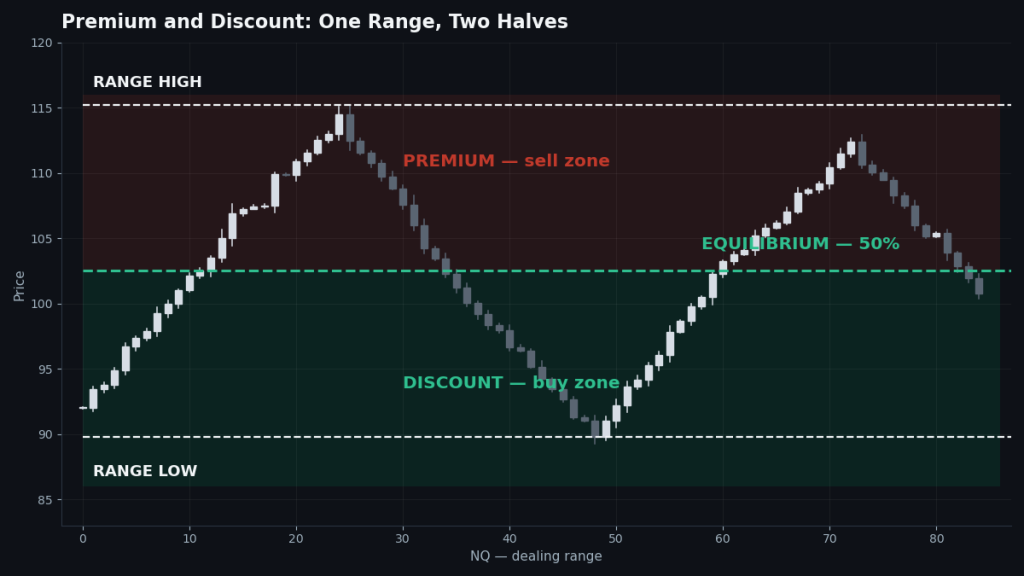
In ICT, premium and discount describe where price sits inside a range. Take any meaningful swing high and swing low — that span is a dealing range. The midpoint of the range is equilibrium (EQ), the 50% level. Price above equilibrium is in premium: relatively expensive for that range, where institutions look to sell. Price below equilibrium is in discount: relatively cheap, where institutions look to buy. That is the entire concept, and it is one of the most useful filters in the framework: buy in discount, sell in premium, and let equilibrium tell you which situation you are actually in before you take any setup. A fair value gap or order block only becomes a high-probability entry when it sits in the correct half of the correct range.
What is a dealing range?
A dealing range is the distance between a significant swing high and a significant swing low that price is currently working inside. It might be yesterday’s range, the overnight range, the current 1-hour leg, or a full weekly range — ICT applies the same logic fractally. The range you choose must match the trade you are taking: a scalp is executed inside the 15-minute range, and its premium and discount are measured there, while the daily range decides whether that scalp is even worth taking.
Ranges are not static. When price breaks out and establishes a new swing, the dealing range updates — the new leg becomes the active range and equilibrium moves with it. The discipline is to always know: which range am I in, and where in it is price right now? Two questions, asked before every decision.
What is equilibrium?
Equilibrium is the 50% level of the dealing range — fair value for that span of price. It earns its keep three ways. First, it is the dividing line between premium and discount, so it defines which direction of trade the range supports. Second, it is a reaction level in its own right: price returning to equilibrium after an extreme move is rebalancing, and what it does there (holds, rejects, slices through) is information. Third, it is the reference for measuring everything else in the range: PD arrays are graded by their position relative to EQ, and targets are often set at EQ first, then the far pool.
How do you identify premium and discount?
- Pick the range. Identify the governing swing high and swing low for your timeframe and trade idea — the last completed leg, the session range, or the daily range.
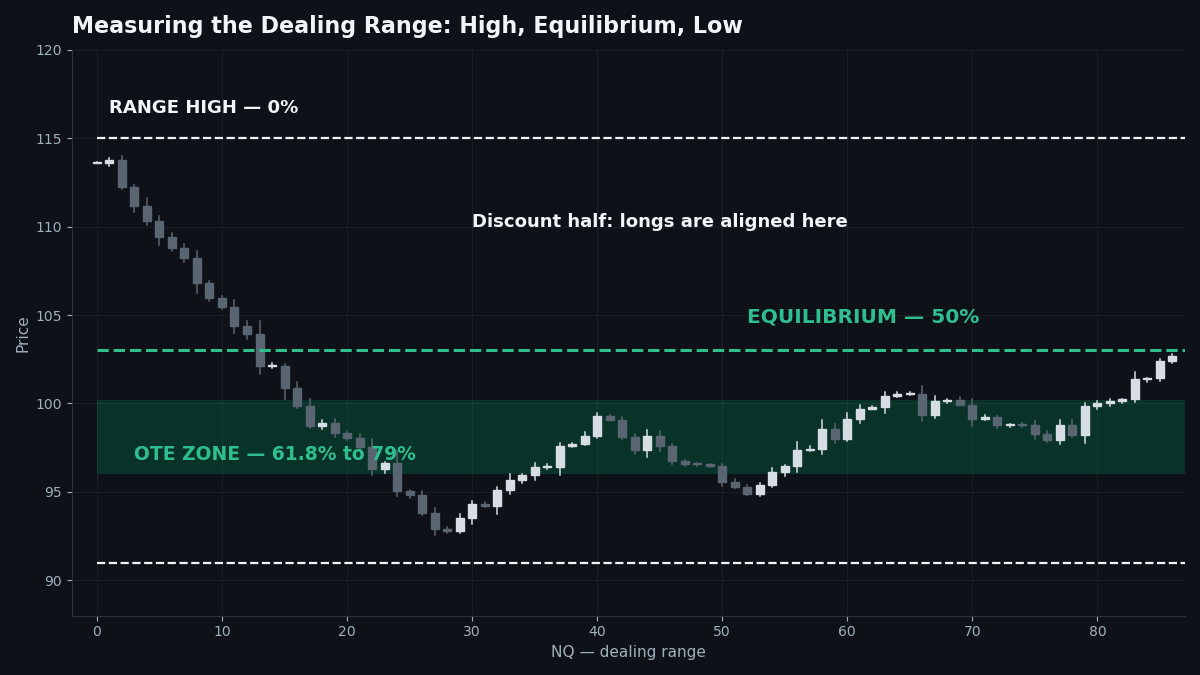
- Anchor a Fibonacci tool (or a simple midpoint line) from the high to the low. Mark 50% — equilibrium. Most ICT traders also mark the 61.8%–79% zone, the optimal trade entry (OTE) band, inside the relevant half.
- Classify price. Above EQ = premium, below EQ = discount. No judgement calls; the line decides.
- Grade your arrays by location. A bullish order block or fair value gap sitting in discount of the range is a candidate long. The identical array in premium is not — whatever it looks like.
- Re-anchor when the range changes. New external swing, new range, new EQ. Stale ranges produce confidently wrong answers.
How do you trade premium and discount on NQ?
The concept is a filter and a targeting tool, used together with structure and liquidity:
- Direction filter. Structure bullish and price in discount of the daily range? Longs are aligned with institutional logic. Structure bullish but price already deep in premium after running buy-side liquidity? The easy part of the move is likely done — stand down or manage, do not initiate.
- Entry location. Wait for your PD array to form inside the correct half. On a bullish day, the morning raid often dips into discount and sweeps sell-side before the real move; the fair value gap it leaves in discount is where the framework says to act.
- Targets in halves. A long from discount targets equilibrium first — partials make sense there — and the premium extremes and the pool above second. This is how a trade gets a realistic objective instead of a hope.
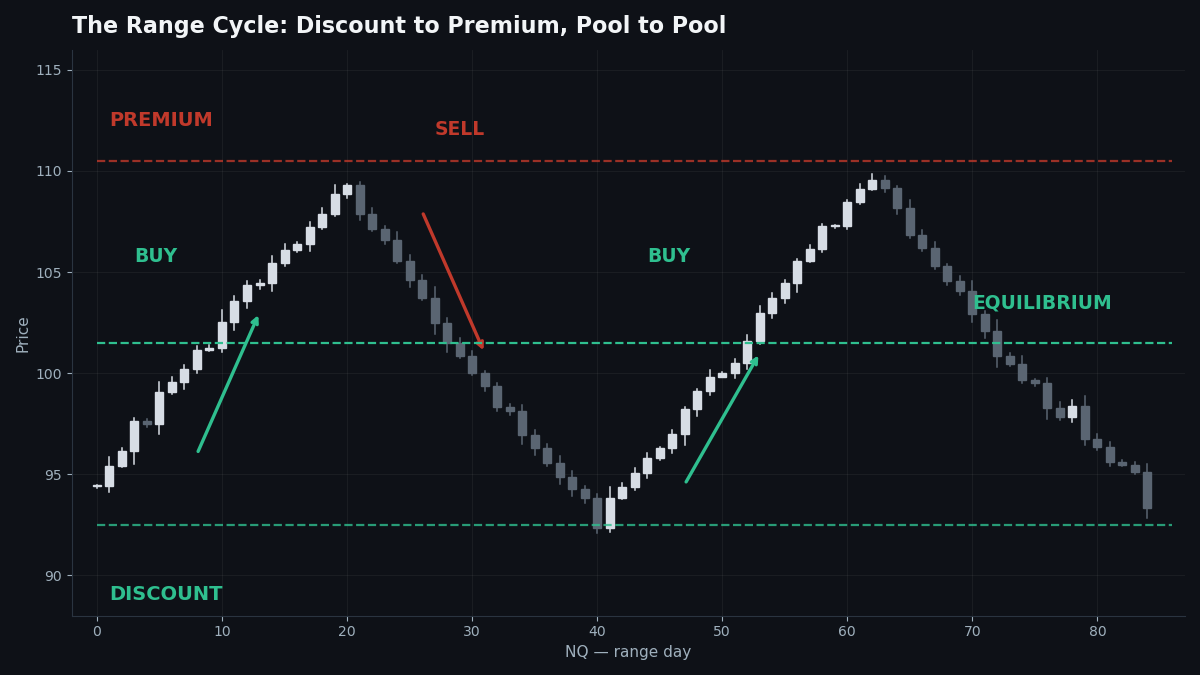
- The range-to-range cycle. Price delivers from discount to premium and back, pool to pool. Watching NQ oscillate inside a daily dealing range — discount entries up to premium, premium rejections back down — is the framework’s daily rhythm, and range days reward exactly this read while punishing breakout-chasing.
The overnight range does the morning’s homework
On NQ, the most practical dealing range of the day is built before you sit down. The overnight session — from the 5:00 p.m. ET futures open through the London hours into the New York open — carves out a range with a high, a low, and an equilibrium. That range frames the morning: if New York opens with price already in the overnight range’s premium after sweeping its high, longs are chasing expensive prices and the framework says wait; if the open raids the overnight low and lands price in overnight discount with structure turning up, the long side has location, a swept pool, and a first target at overnight equilibrium. Marking the overnight high, low, and EQ takes two minutes before 8:30 a.m. and quietly prevents the most common NQ error of all — trading the right idea in the wrong half of the range.
Worked example: NQ makes its day high in the first hour, sweeping the overnight highs, then sells off. By 10:30 it is below equilibrium of the day’s range and takes the overnight low — sell-side swept, in discount. A bullish market structure shift with displacement off that low is now aligned with everything: liquidity taken, discount reached, structure turning. The long into the displacement’s gap, targeting equilibrium then the highs, is premium-and-discount doing its job — it told you where the shift was worth trading.
Common mistakes
- Using the wrong range. Measuring premium/discount on a random 5-minute wiggle while the daily range says the opposite is how traders buy “discount” at the top of the day. The governing range is the one your trade idea lives in — and the higher-timeframe range outranks the lower.
- Buying discount in a bearish market. Discount is cheap relative to the range, not cheap in absolute terms. In bearish structure, discount of a falling range is where price pauses before continuing. Location never overrides structure; it refines it.
- Treating equilibrium as a magnet that must be touched. EQ is a reference and a common reaction level, not a law. Strong trends slice through it without looking back. Use it to classify and to set first targets, not to fade momentum.
- Forgetting the range moved. After a break of structure and a new swing, yesterday’s premium can be today’s discount. Re-anchor. Traders lose money defending a classification the market updated an hour ago.
- Skipping the filter because the array “looks perfect.” The most expensive fair value gaps on NQ are the beautiful ones in the wrong half of the range. The filter exists precisely for them.
FAQ
What is premium and discount in ICT?
Premium is the half of a dealing range above its 50% midpoint, where price is relatively expensive and institutions sell. Discount is the half below the midpoint, where price is relatively cheap and institutions buy.
What is equilibrium in ICT?
The 50% level of a dealing range — fair value for that range, and the line that separates premium from discount. It is used to classify price location, grade PD arrays, and set first targets.
What is a dealing range?
The span between a significant swing high and swing low that price is currently trading inside — a session range, a daily range, or a single price leg. Premium and discount are always measured against a specific dealing range.
Should you always buy in discount and sell in premium?
As a filter, yes — entries aligned with the correct half of the range are higher probability. But location never overrides market structure: discount inside bearish structure is not a buy signal by itself.
How do premium and discount relate to the OTE?
The optimal trade entry zone (61.8%–79% retracement) sits inside the discount half for longs and the premium half for shorts. OTE is premium/discount thinking applied to a single leg — it gets its own page in Week 3 of this section.
Which range should I use on NQ?
Match the range to the trade: the daily range for bias and location, the session or 15-minute range for execution. When they disagree, the higher-timeframe range governs.
Where to go next
Premium and discount complete the foundation set. Go back to the ICT section hub for the full map, pair this with ICT liquidity — the pools sit at the range extremes — and ICT market structure for the delivery that moves price between them.