Trailing drawdown follows your account’s high-water mark in real time — every new peak raises the floor, intraday. End-of-day drawdown only recalculates once, at the previous day’s close, and stays fixed all session. For beginners, end-of-day is the friendlier rule by a wide margin. Here’s why.
Trailing Drawdown, Plain English
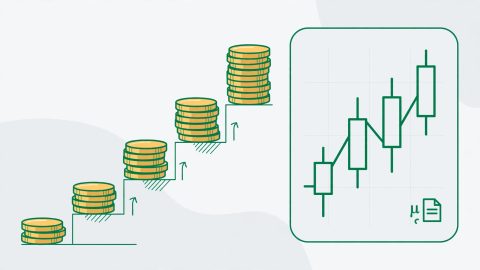
Your account has a maximum drawdown — say $2,000 on a 50K evaluation. With a trailing drawdown, the line your balance can’t cross moves up as you make money, tick by tick.
Example. You start the day at $50,000. The no-go line is $48,000.
- You win $500 in the morning. Balance: $50,500. The line moves up to $48,500.
- You win another $500. Balance: $51,000. The line is now $49,000.
- You give back $800 in the afternoon. Balance: $50,200 — still above your $49,000 line, fine.
- But if you’d given back $2,100 instead, you’d breach — even though you’re still up $100 on the day.
That’s the cruelty of trailing drawdown: you can be profitable overall and still fail the evaluation, because the floor chased your profits upward intraday and your normal pullback crossed it.
End-of-Day Drawdown, Plain English
With end-of-day (EOD) drawdown, the floor is set once — from the prior day’s closing balance — and doesn’t move until the next close.
Same example. You start at $50,000. The line is $48,000, and it stays there all day no matter what.
- You win $500, then $500. Balance: $51,000. The line is still $48,000.
- You give back $800. Balance: $50,200. Fine — miles above the line.
- Even if you gave back $1,500, balance $49,500 — still fine. The line doesn’t move until tomorrow’s open, when it recalculates from the close.
Your intraday swings don’t tighten the noose. Only the closing balance matters.
Why Trailing Intraday Drawdown Kills Beginners
Beginners don’t lose because their strategy is broken. They lose because of sequence:
- Morning winner, afternoon giveback. The most common beginner pattern — green by 10 AM, red by noon. Under trailing drawdown, that normal round-trip can breach the account. Under EOD, it’s just a flat day.
- Winners become liabilities. On trailing drawdown, every winning trade raises the floor and shrinks your remaining room. Beginners start fearing their own winners — cutting them short, which ironically makes the math worse.
- No room to be wrong intraday. Learning requires trades that don’t work. Trailing drawdown punishes the normal learning process: a few small losses after a winner can end the evaluation even with a positive expectancy.
This is why so many traders “pass the eval and blow the funded account in a week.” They survived the trailing drawdown once by luck of sequence — then the same normal variance killed them the next time.
Why the Industry Moved Toward End of Day
Prop firms figured out that trailing intraday drawdown was failing good traders for bad reasons. A trader who makes $1,000 and gives back $600 is demonstrating exactly the kind of controlled trading a firm wants to fund — but trailing drawdown can fail them for it.
End-of-day drawdown keeps the risk control (you still can’t lose more than the max) while removing the intraday trap. The firm still protects its capital. The trader gets room to actually trade.
When you’re choosing where to buy an evaluation, the drawdown type matters as much as the drawdown size. A $2,000 EOD drawdown is meaningfully easier to survive than a $2,000 trailing drawdown — they’re not the same product even though the number matches.
The Question to Ask Before You Buy
Don’t just ask “how big is the drawdown.” Ask two questions:
- Does it trail intraday, or is it end-of-day? This single distinction changes the difficulty more than the dollar figure does.
- Does the trailing stop once funded? Some firms trail during the evaluation but lock the drawdown at the starting balance once you’re funded. That’s a meaningful upgrade — know which phase you’re buying.
A $2,000 EOD drawdown that locks at breakeven when funded is one of the fairest deals in the industry. A $2,000 trailing drawdown that keeps trailing forever is one of the hardest. Read the rules page twice before you pay.
How to Trade Each One
If you’re on trailing drawdown: Bank morning profits by reducing size in the afternoon, not by quitting — you still need reps. Know your exact live floor at all times. Most blown trailing accounts happen because the trader didn’t realize how far the line had moved up. Never “trade back” to a new high-water mark. That’s how the floor gets impossibly tight.
If you’re on end-of-day drawdown: You still need a personal daily stop. EOD gives you room — don’t use that room as permission to be sloppy. Size from the fixed line. Your max risk per trade should assume the worst realistic day, not the average one. The close is the only number that matters. Manage the day so the close is green or flat, and the drawdown takes care of itself.
The Bottom Line
Trailing drawdown moves the floor up with every intraday profit, so normal giveback can fail you. End-of-day drawdown sets the floor once at the prior close and leaves it alone, giving you room to trade. Same dollar figure, very different difficulty — beginners should strongly prefer EOD.
Before you buy any evaluation, figure out how many accounts you actually need and what the real monthly math looks like: run the free prop firm calculator. It’ll show you eval spend, expected payouts, and risk per trade for your numbers in about thirty seconds.
New to futures? Don’t buy an evaluation until you understand what you’re trading. My free 24-day email course starts from absolute zero — what futures are, how NQ moves, how orders and risk actually work — one short email a day.
Frequently Asked Questions
What is trailing drawdown in prop firm trading?
Trailing drawdown is a rule where your maximum-loss floor rises with your account’s highest balance in real time. If your high-water mark goes up $500, the level that would breach your account also goes up $500 — intraday. You can be up on the day overall and still breach if a pullback crosses the raised floor.
What is end-of-day drawdown?
End-of-day drawdown sets your maximum-loss floor once per day, based on the previous day’s closing balance, and it doesn’t move until the next close. Intraday profits don’t raise the floor, so normal ups and downs during the session can’t trap you the way trailing drawdown can.
Which is better for beginners, trailing or EOD drawdown?
End-of-day, clearly. Beginners naturally have choppy equity curves — morning winners followed by afternoon giveback — and trailing drawdown punishes exactly that pattern. EOD keeps the same overall risk limit while giving you room to learn without the floor chasing your profits.
Do all prop firms offer end-of-day drawdown?
No — drawdown types vary by firm and even by account type within a firm. Always read the specific rules of the evaluation you’re buying: look for whether the drawdown “trails intraday” or is “calculated end-of-day,” because a $2,000 trailing drawdown and a $2,000 EOD drawdown are very different challenges.