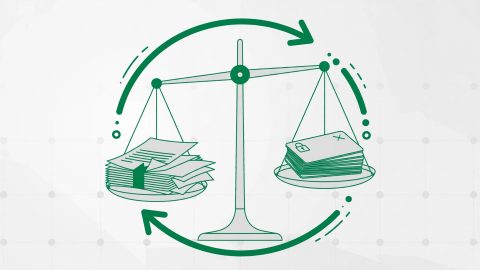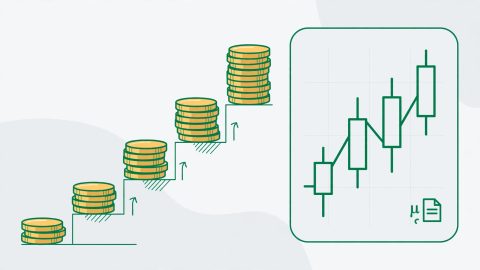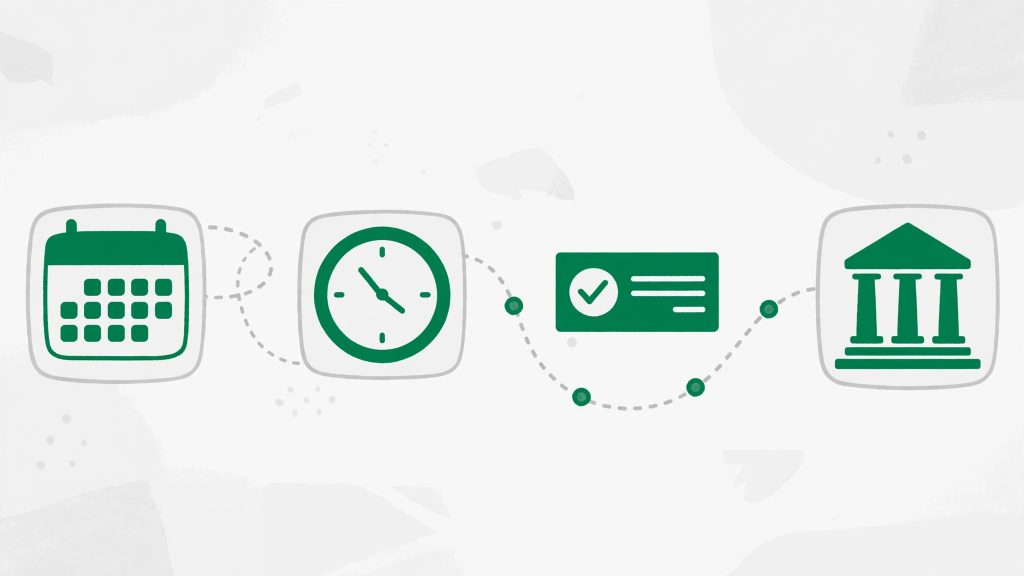
A prop firm payout takes two separate waits, and most traders only count one of them. First comes the eligibility wait — the trading days, payout cycle, and minimums your firm requires before you can even ask. Then comes processing: the firm’s review and approval, plus the time your payment rail needs to actually land the money in your account. Add both clocks together and you have the honest answer for your firm.
That is why two traders at two different firms can both be telling the truth when one says “I got paid in a day” and the other says “mine took three weeks.” They are not measuring the same thing. This post breaks the timeline into its real stages and shows you where delays actually happen.
A Payout Runs on Two Clocks, Not One
The eligibility clock starts the day you get funded. It covers everything the firm makes you complete before the payout button works: a minimum number of trading days, a payout cycle (on-demand, weekly, every five trading days, bi-weekly, or monthly, depending on the firm and plan), a minimum profit or minimum withdrawal amount, and any consistency rule that caps how much of your total profit can come from a single day.
The processing clock starts the moment you submit the request. It covers the firm’s internal review, the approval, and the settlement time of the payment method you chose.
A firm that processes in hours but only lets you request once a month can be slower in real life than a firm that processes in three business days but lets you request the day you qualify. When you compare firms, compare the full path — eligibility plus processing — not the headline processing claim. If you want to run the numbers on how many accounts and how much buffer that path requires, that is exactly what the prop firm calculator is built for.
Stage 1: Becoming Eligible to Ask
Nothing moves until you clear this stage, and it is where most calendar time hides.
Minimum trading days. Many firms require you to have traded a set number of separate days on the funded account before the first request. Those are trading days, not calendar days — a long weekend does not move you closer.
The payout cycle. Some plans pay on demand once you qualify. Others run on fixed windows: every five trading days, weekly, every two weeks, or once a month. Miss a window and you wait for the next one.
Minimum profit or withdrawal thresholds. Some firms will not process a request below a set dollar amount. If your profit sits just under the line, the clock is not running at all — you still have trading to do.
Consistency rules. Where a consistency rule applies, one oversized day can block a request even when total profit looks fine. The fix is more qualifying profit spread across more days — again calendar time, not processing time.
Read these four items in your firm’s current rules before you trade the funded account, not after. They decide your real payout date more than anything the payments team does.
Stage 2: The Firm’s Review
Once you submit, the firm checks the request against the account. This is mostly mechanical:
- Did you meet the minimum trading days and the payout cycle?
- Did any day break the daily loss limit or the drawdown rule?
- Does your best day stay inside the consistency cap, if your plan has one?
- Were you flat when you requested, if your firm requires that?
- Is your identity verification complete, and does the name on the payout method match the name on the account?
Straightforward reviews at organized firms are typically a matter of business days, not weeks. Reviews slow down when something needs a human: a flagged trade, a mismatch in verification documents, or a first payout that triggers the full compliance check. Weekends and holidays stretch every step, because firms count in business days.
Stage 3: Approval and the Payment Rail
Approval is not arrival. Once the firm releases the money, the rail you chose takes over, and rails have very different speeds:
- Crypto payouts are usually the fastest after approval, often landing the same day, because there is no bank cutoff to wait on.
- Payment platforms such as Rise are built for contractor-style payouts and typically settle quickly once released, though your first withdrawal to a new destination can take longer while details are verified.
- Bank wires are the slowest common rail. Domestic wires can take one to three business days after release, and international wires can take longer, especially across weekends and time zones.
This is the stage firms control least. When a firm says a payout was “processed,” it usually means released to the rail — not sitting in your bank account. Judge a firm by the full request-to-bank timeline that traders actually experience, and keep your own records of each date: requested, approved, released, received.
Why Your First Payout Is the Slowest One
Expect the first payout to take the longest, and plan for it instead of panicking about it. The first request is when most firms complete identity verification (KYC): a government ID, sometimes proof of address, and tax documentation — a W-9 for US traders or a W-8BEN for non-US traders at firms that collect them. Your payout destination also gets verified on the first run.
Every payout after that reuses the verified details, which is why later payouts at the same firm usually move faster. A slow first payout with clear communication is normal. A slow payout with no communication, changing explanations, or new requirements invented mid-request is a different signal — that pattern is covered in our guide to why prop firm payouts get denied.
What Actually Causes Delays
Most delays are boring and fixable:
- Requesting before you are eligible. Minimum days not met, cycle not open, or profit under the threshold. The request stalls or gets rejected and you start the wait over.
- A consistency problem. One big day doing most of the work. The fix is more balanced profit, which takes more trading days.
- Trading after you request. At some firms, a balance that drops after the request — or an open position at request time — voids or pauses the payout. Know your firm’s rule and respect it.
- Verification mismatches. A payout account in a different name, an expired ID, or a tax form never submitted. All of these stop the clock cold.
- Bank-side holds. First-time or larger incoming transfers sometimes get reviewed by your own bank. That delay is real, and it is not the firm stalling.
Do the Payout Math Before You Celebrate the Profit
A payout timeline only matters if the amount is worth waiting for, so run the math on your own trading. On NQ, one point is worth $20 per contract: a 25-point move captured on one contract is $500 of account profit before your split. On MNQ, the same 25 points is $50, because MNQ pays $2 per point.
Now stack the firm’s terms on top: your split decides your share, any buffer or threshold decides how much profit must stay in the account, and the cycle decides when you can touch it. Two accounts with identical profit can produce very different payouts on very different dates. That is the comparison that matters — model the whole path, not the split headline, before buying an evaluation.
How to Keep Your Payout Fast
- Read the payout rules before you pass, not after. Minimum days, cycle, thresholds, consistency — know all four numbers for your exact plan.
- Finish verification early. Complete KYC and tax forms when the firm first offers them, not while a payout waits on them.
- Trade like the review is coming. Spread profit across days, respect the daily loss limit with room to spare, and be flat when you request if your firm requires it.
- Request cleanly and then leave it alone. Submit inside the window, with matching details, and do not trade in ways your firm’s rules say can void the request.
- Keep your own timeline log. Requested, approved, released, received. If a firm ever does stall, your dates are your evidence.
Start With the System, Then Worry About Payout Speed
A fast payout on a blown account is worth nothing. The traders who collect payouts month after month have a repeatable process first: I trade NQ with the 7AM Model — price and time only, no indicators — and the same discipline that keeps a funded account alive keeps payout requests boring and routine. If you are building that foundation, start with the free course and then look at how the 7AM Model structures the trading day.
FAQ
How long do prop firm payouts take in total?
Add the two clocks: the eligibility wait (minimum trading days, payout cycle, and thresholds, which can run from zero days to a full monthly cycle) plus processing (the firm’s review, usually a matter of business days, plus your payment rail’s settlement time, from same-day for crypto to several business days for an international wire). Plan on days to a couple of weeks from qualifying profit to money in the bank — with the first payout at the slow end.
Why is my prop firm payout still pending?
The common causes are an eligibility item not yet met, a consistency check that needs more balanced profit, incomplete identity or tax verification, a name mismatch on the payout method, or a request submitted outside the firm’s payout window. Check each of those against your firm’s rules first — most pending payouts are one of those five, and most are fixable by you.
Which payout method is fastest?
After approval, crypto is usually fastest, often arriving the same day. Payment platforms built for contractor payouts, such as Rise, are typically next. Bank wires are slowest, at one to three business days domestically after release and longer internationally. Remember that the method only affects the last stage — it cannot shorten the eligibility wait or the firm’s review.
Does requesting a payout affect my funded account?
At many firms, yes — a withdrawal can lower your account balance and, at firms where the drawdown trails the balance, move your drawdown floor. Some firms also require you to stop trading or stay flat around a request. Read your plan’s withdrawal rules before you request, and size the request so the account that remains is still an account you can trade safely.